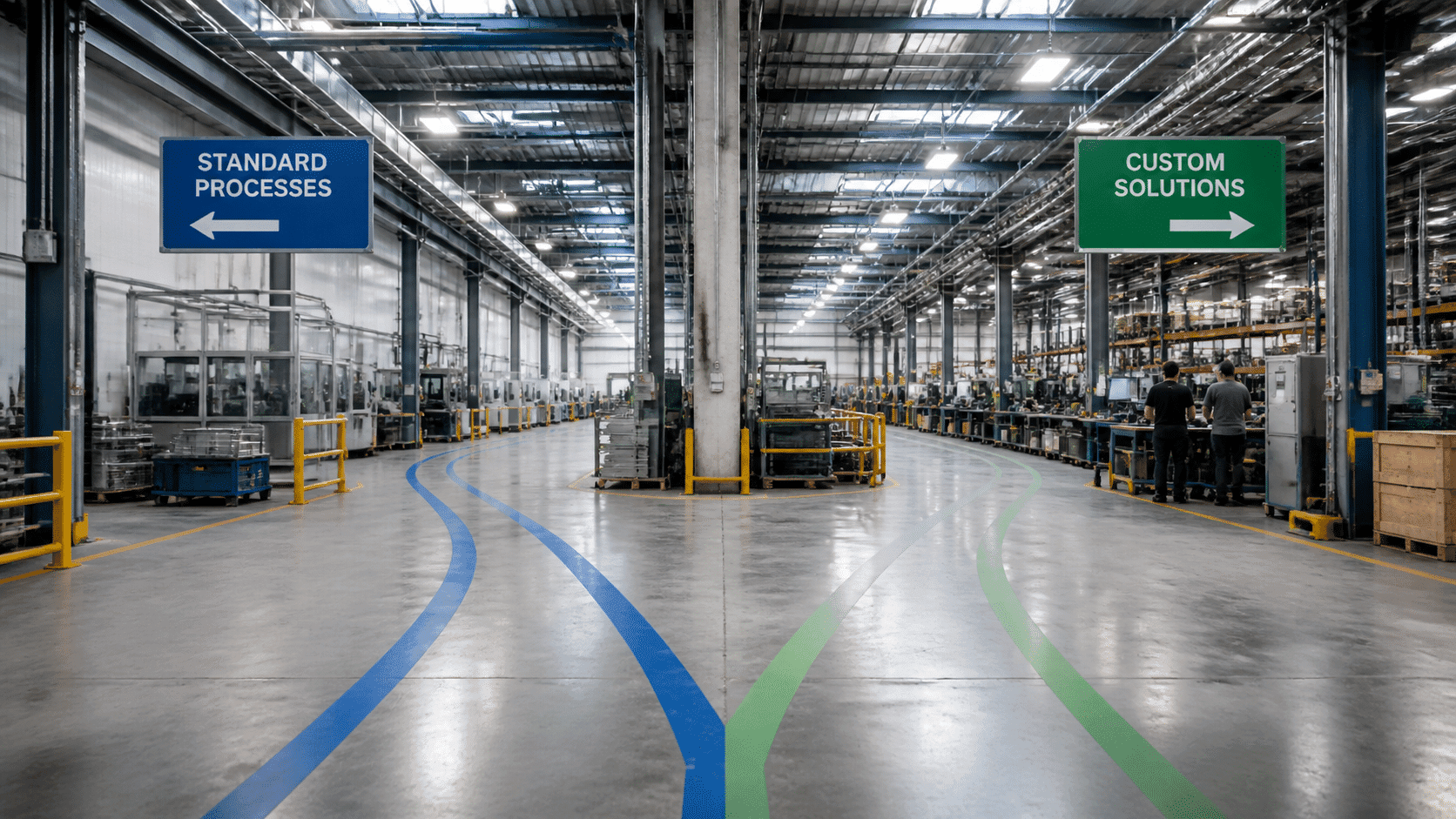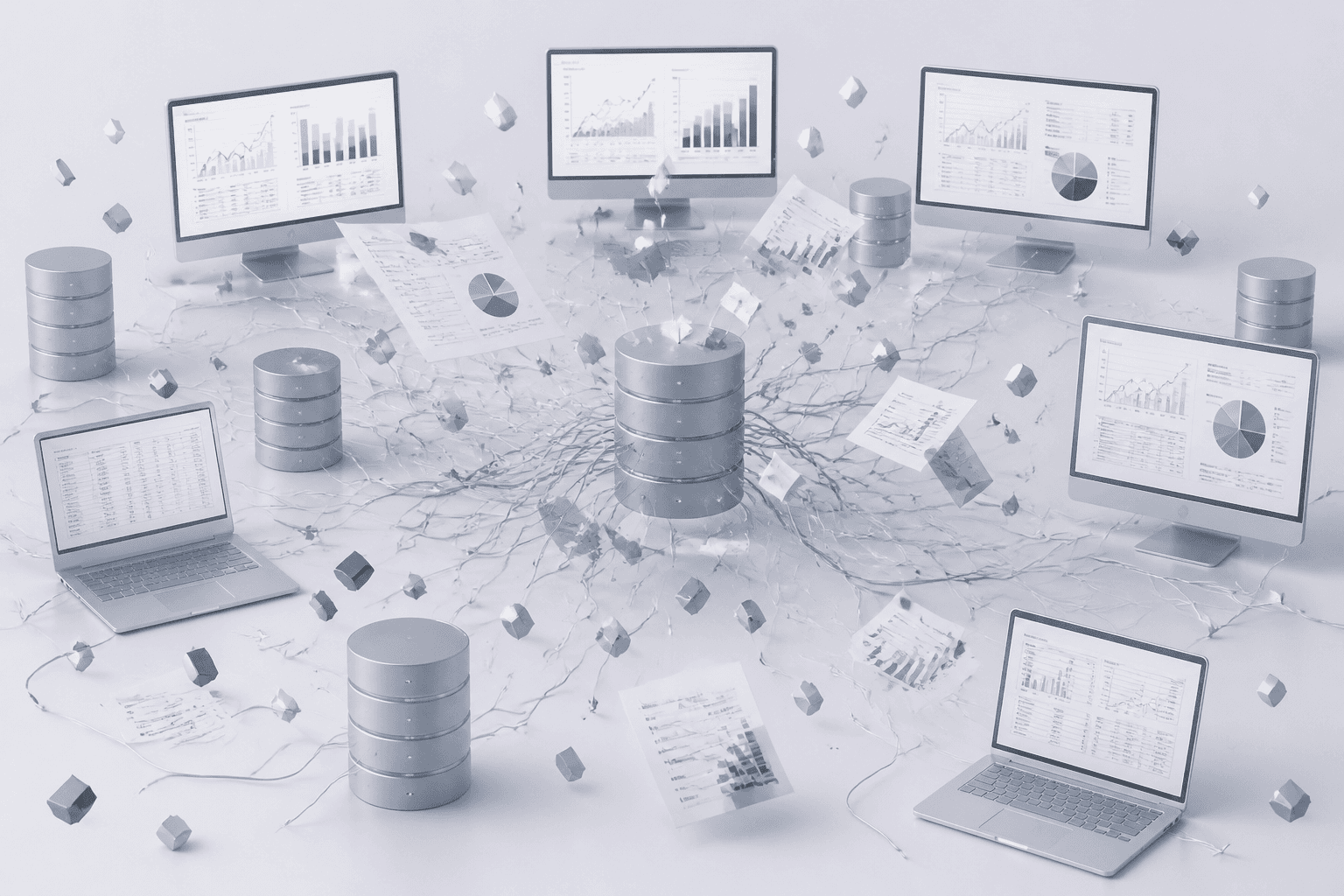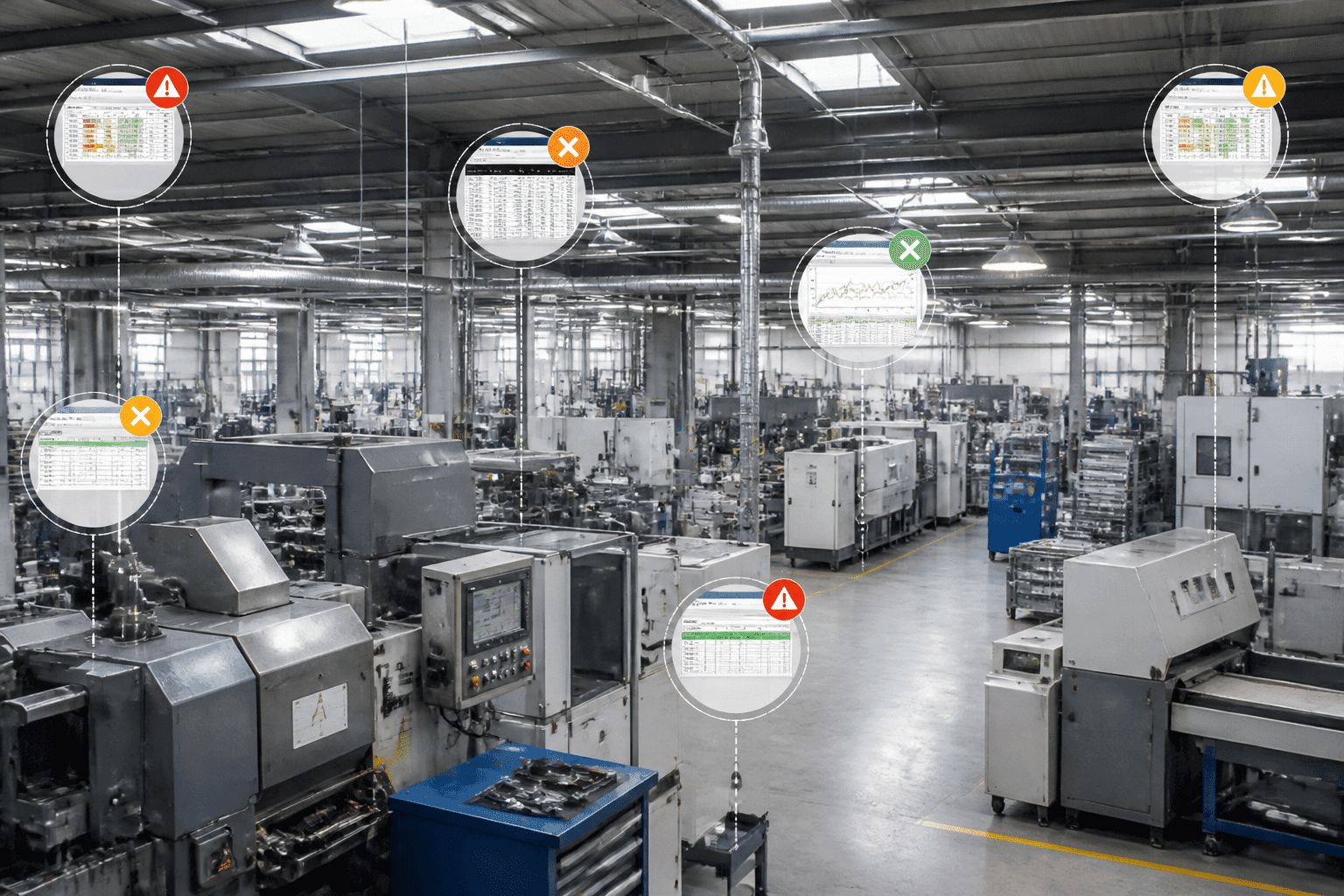
Introduction: The Disconnected Factory and the Case for a Unified Digital Core
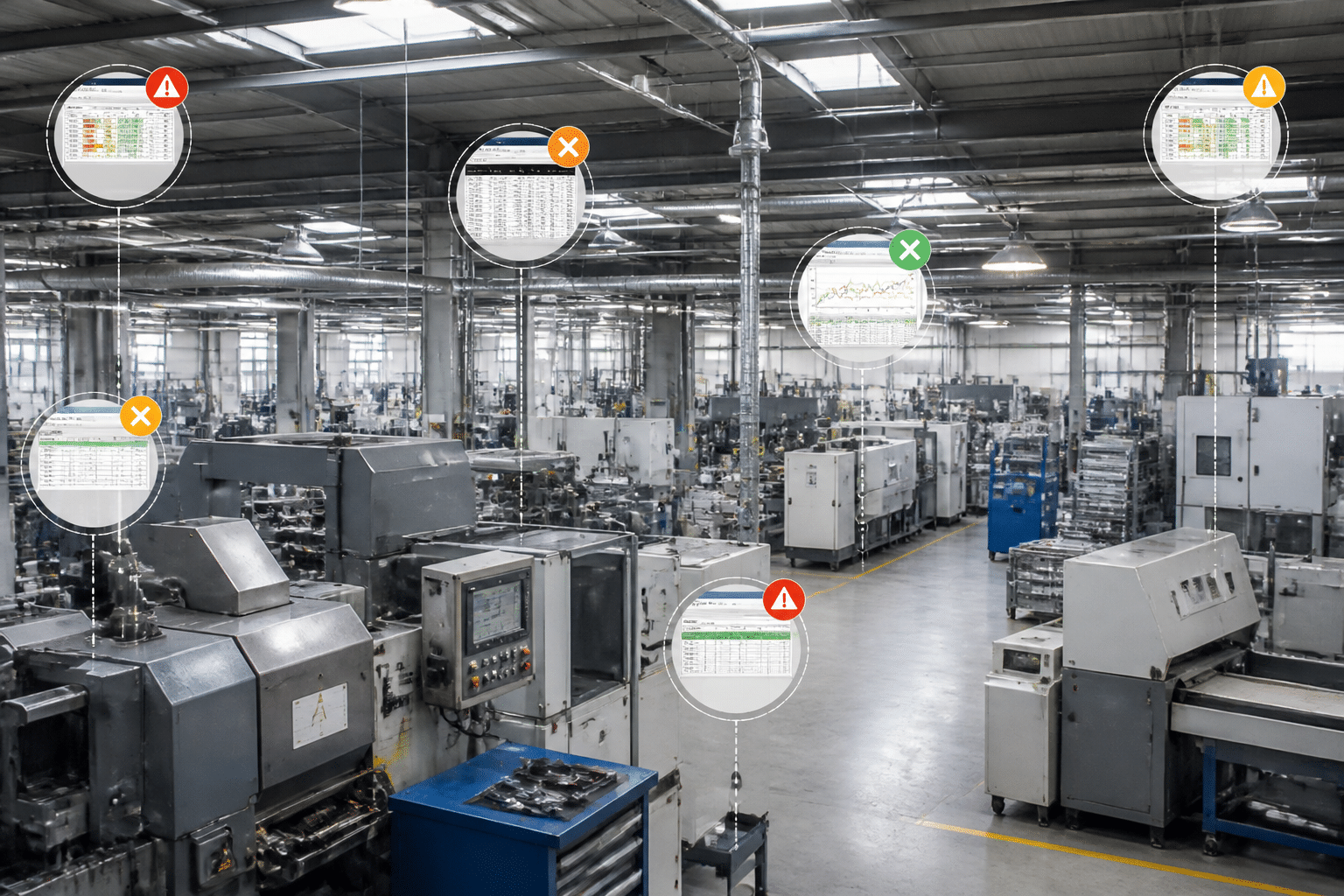
Here's a number that should bug you. Only 36% of manufacturers say their current data actually supports good decisions, according to Dun & Bradstreet's 2025 Manufacturing Pulse Survey. And 54% have the same data sitting in more than one system.
Sound familiar? You bought a strong ERP. It runs finance, purchasing and planning just fine. But out on the floor, machines, schedulers and quality teams work from their own tools, and someone ends up copying numbers into a spreadsheet at 6am. That's the disconnected factory.
The cost is real. Late orders, wrong stock counts, and decisions made on yesterday's numbers. Plus, AI projects stall when the data underneath is messy. KPMG found that 76% of industrial manufacturing executives see unreliable data as their biggest AI risk.
The fix isn't another standalone app. It's a unified digital core, where your ERP software for manufacturing talks to MES, supply chain tools, IoT sensors and everything else in real time. One version of the truth, from the dock to the boardroom.
This guide is for CTOs, CIOs and IT directors who want to get there. We'll look at what to connect, how to plan it, and where projects tend to go sideways, so your operation ends up resilient, efficient and ready for what's next.
1. Why Standalone ERP Can No Longer Keep Pace with Modern Manufacturing Demands
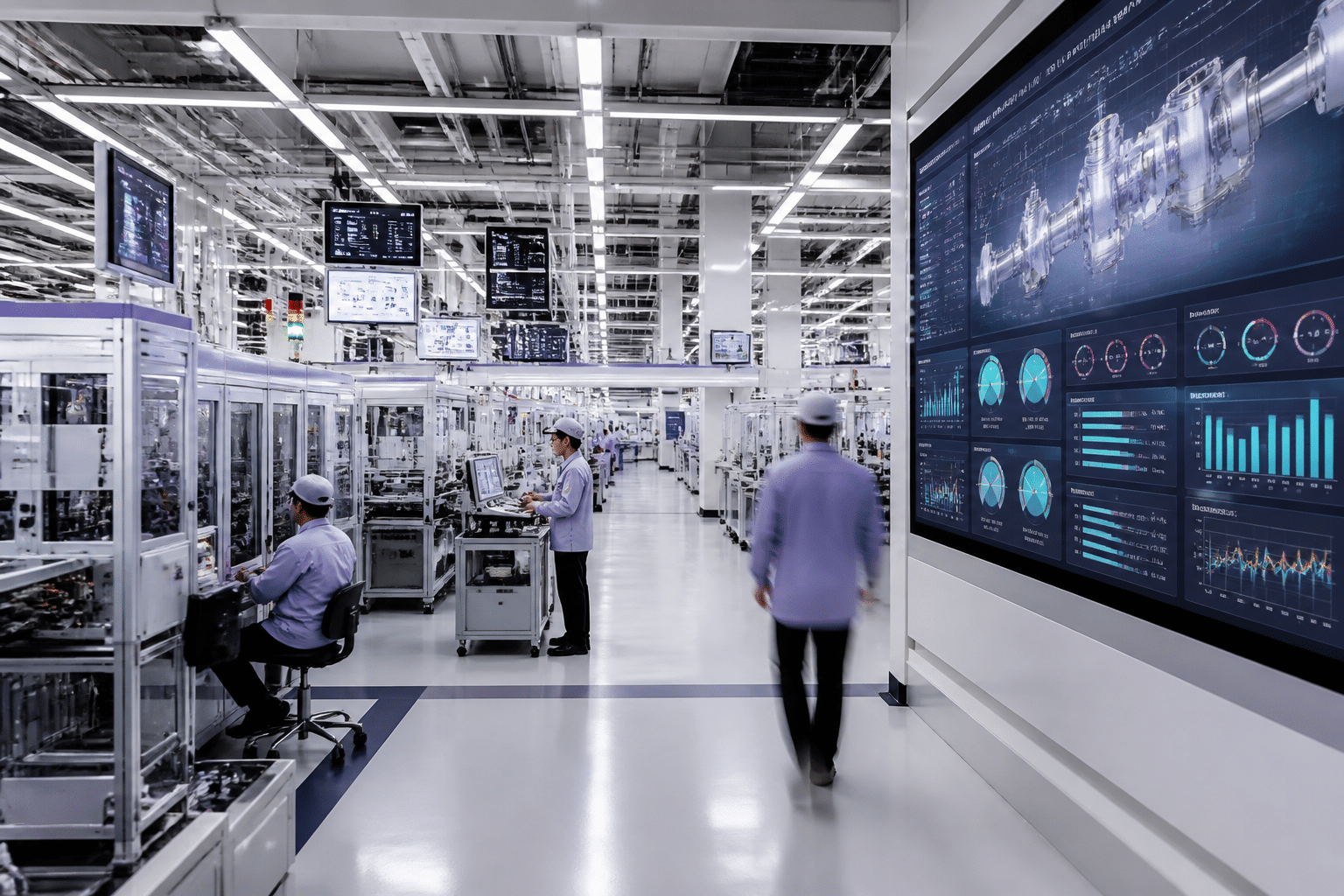
Your ERP wasn't built for today's pace. It was built to record what already happened. That worked fine when plants ran long, steady batches. It doesn't work now.
Three Pressures That Changed the Rules
First, Industry 4.0. Machines, sensors and software now produce data every second, and a plan that updates once a day can't use it.
Second, customers want things their way. Custom options, smaller batches, faster changeovers. Every change in the order book shifts schedules, materials and labor, and your team needs to see that shift as it happens.
Third, supply chains are jumpy. One 2026 survey found that 94% of manufacturers rank resilience higher than they did five years ago. So real-time data flow isn't a nice extra anymore. It's the baseline.
What Breaks When ERP Stands Alone
Without connecting ERP to factory systems, the gaps show up fast:
Slow production insights. Output and scrap reach the ERP hours late, if someone types them in at all.
Wrong inventory. The system says 400 units are on the shelf. The floor says 310. Guess who's right.
Reactive upkeep. Maintenance waits for a breakdown instead of acting on warning signs.
Late quality catches. Defects get found after a whole lot is built, not after the first bad part.
Tacton's 2025 survey found that 55% of manufacturers still rely on manual reporting like spreadsheets. That's the gap in action.
Siloed factory | Connected smart factory | |
|---|---|---|
Production data | Typed in later by hand | Flows from machines to ERP live |
Inventory | Counts drift from reality | Updates with every material move |
Maintenance | Fix it after it fails | Sensors flag trouble early |
Quality | Found at final inspection | Caught at the line, logged instantly |
Decisions | Based on yesterday | Based on right now |
What It Costs You
These gaps hit numbers you actually report. Hidden downtime and slow changeovers drag down Overall Equipment Effectiveness (OEE). Rework, expedited freight and extra safety stock push costs up. And your rivals who run smart factory ERP solutions can quote faster and ship more reliably.
The stakes are growing. Deloitte found that 92% of manufacturing executives expect smart manufacturing to drive competitiveness over the next three years. Standing still means falling behind.
So what exactly should you connect? Let's look at that next.
2. The Core Technologies to Integrate with Your Manufacturing ERP
So what do you actually connect? Not everything at once. Four systems do most of the heavy lifting: MES, industrial IoT, PLM and supply chain tools. Each one fills a gap your ERP can't fill alone.
Here's the quick map before we go system by system.
Technology | What it does | Data it swaps with the ERP | Where it hurts if missing |
|---|---|---|---|
MES | Runs and records work on the floor | Orders, BOMs, routings down; counts, scrap, labor time up | Late, hand-typed production data |
IIoT | Reads machines and sensors live | Alerts, asset condition, maintenance triggers | Surprise breakdowns |
PLM | Holds the approved product design | Item master, revisions, engineering changes | Building to the wrong revision |
SCM | Plans and tracks supply and demand | Forecasts, supplier commitments, stock, shipments | Shortages found too late |
a) MES for Real-Time Production Visibility
Think of it this way. ERP sends the plan. MES records what really happened.
Before: Supervisors write down counts on paper. Someone keys them into the ERP the next morning. By then the shift is over and the scrap is already in the bin.
After: ERP and MES integration pushes production orders, bills of material and routings to the floor. The MES sends back good quantity, scrap, material use and machine time as work happens. Quality alerts land in the ERP right away, and lot genealogy stays attached to every finished unit.
The payoff? Your schedulers stop guessing. And finance sees true job costs instead of estimates.
b) IIoT for Predictive Analytics
Sensors already know when a motor is running hot. The question is whether anyone with the power to act hears about it.
Before: An alarm goes off on the floor. A technician notices (maybe). Spare parts get ordered after the line stops.
After: IoT and ERP in manufacturing work as one loop. Sensor data feeds a prediction, the prediction creates a maintenance work order, and the ERP checks spare parts and reserves them. One 2026 case study connected predictive-maintenance software to SAP ERP and Oracle WMS through REST APIs. It predicted conveyor failures with 94.8% accuracy and cut unplanned downtime by 60%, with maintenance costs down 28%.
One conveyor system isn't a promise for your plant, so treat it as a benchmark and not a guarantee. Pepperl+Fuchs also describes an Industry 4.0 setup reporting more than $300,000 in yearly savings from connected production data.
One practical catch: older machines rarely speak modern protocols. That's often where custom ERP integration comes in, the kind of work a partner like Buildera does around legacy equipment.
c) PLM for a Unified Product Data Thread
This one gets overlooked. And it quietly causes some of the most expensive mistakes.
Before: Engineering approves a design change in PLM. Purchasing still orders parts from last month's spreadsheet. The floor builds to revision B while the drawing says C.
After: The released item master, revision-controlled BOM, specs and engineering-change status flow from PLM into the ERP. Purchasing and production work from the approved design, full stop. Everyone pulls from one product thread, from first sketch to shipped unit.
I couldn't find a solid public number for PLM and ERP savings, so I won't invent one. But if you've ever scrapped a batch over a wrong revision, you already know the cost.
d) SCM for End-to-End Supply Chain Control
Your ERP knows what's in your own warehouse. It doesn't automatically know what your supplier's truck is doing.
Before: Planners chase suppliers by email. A late component shows up as a surprise on the day the line needs it.
After: Demand, inventory, supplier commitments and production plans sync in one place. That's supply chain optimization with ERP at its most practical: you see the shortage coming and replan before the line stops.
Does visibility really help? A 2025 study of 526 listed manufacturers found that supply chain visibility improves firm resilience. But here's the twist. A separate study of 479 Australian manufacturers found visibility alone wasn't enough. Responsiveness and collaboration mattered too. So don't just buy a dashboard. Make sure someone can act on what it shows.
Now you know what to connect. Next, let's look at what it's worth to your business.
3. The Strategic Business Benefits of a Fully Integrated ERP Ecosystem
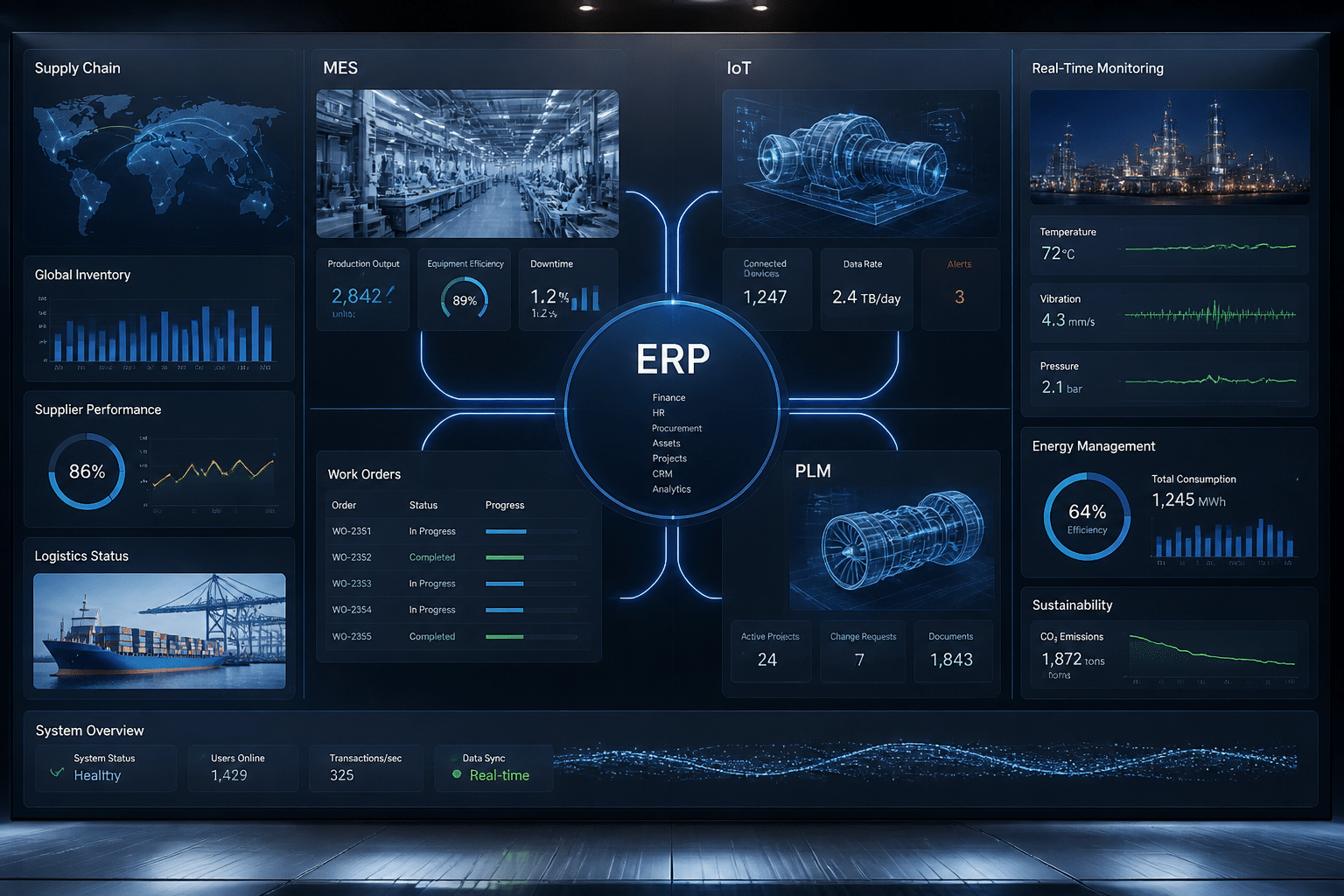
Technical wins are nice. But your CEO and CFO don't care about REST APIs. They care about margin, delivery dates and risk. So let's translate.
Integration pays off in three places: better decisions, leaner operations and a business that bends instead of breaks.
Pillar 1: Decisions You Can Actually Trust
Bad data makes smart people guess. Hexagon's executive survey found that 73% of industrial leaders see poor data integration as a major operational issue, and 56% said their digital efforts hadn't delivered the ROI they expected. Those two numbers are probably related.
KPMG's Martin Kaestner put the fix plainly in the firm's industrial manufacturing tech report: "The true potential of AI is realized when data from disparate systems, such as customer relationship management and procurement platforms, is aggregated and analyzed holistically."
In practice, that means forecasts built on live demand and costing based on what a job really used, not what someone estimated.
Pillar 2: Operations That Waste Less
This is where manufacturing ERP integration shows up on the floor. Fewer surprise stops. Less rework. Less stock sitting around "just in case."
A 2025 case study from Rishabh Soft on an apparel manufacturer is a good example. After modernizing its legacy ERP and MES setup, planning and inventory processing dropped from 10 days to seven. Data accuracy rose from 90% to 98%. Defects fell from 8% to 5%.
On the maintenance side, Zerynth's industrial IoT benchmarks point to up to 25% lower downtime and 10 to 20% higher production efficiency. That's vendor data, so treat it as a rough target, not a promise.
Pillar 3: Agility When Things Go Sideways
A rush order lands. A supplier slips. Can you re-sequence the week by lunchtime? With connected systems, planners see material, machine time and labor in one view, so they can pivot fast.
That matters more every year. In KPMG's 2026 U.S. Supply Chain Survey, six in ten industrial manufacturing respondents named stronger resilience as the main driver of operating model change. And as we saw earlier, visibility only helps if your team can respond to it.
The World Economic Forum also points to leading "Lighthouse" factories that cut energy costs and time to market by 40% while lifting productivity by 70%. Those are the extreme cases, but they show the ceiling.
The Benefits at a Glance
Pillar | What changes | Reported result |
|---|---|---|
Smarter decisions | One trusted data set across ERP, MES and supply chain | Data accuracy up from 90% to 98% |
Operational efficiency | Less downtime, fewer defects, faster planning | Up to 25% lower downtime; defects down from 8% to 5% |
Agility and resilience | Faster replanning, clearer supply view | Lighthouse factories: 40% faster time to market |
Your numbers will differ. A plant on cloud ERP for manufacturing with clean master data will see gains sooner than one still fighting duplicate part numbers. Custom ERP integration around older equipment can close that gap, which is where a partner like Buildera usually comes in.
So how do you get these results without a messy rollout? That's the plan we'll build next.
4. A 5-Step Framework for Planning Your Manufacturing ERP Integration
You know what to connect and why it pays. Now comes the part that keeps IT leaders up at night: how to actually do it without stopping a plant. The answer is boring in the best way. Go in order, go in small pieces, and show a win early.
Here's the whole path at a glance.
Step | What you do | What you walk away with |
|---|---|---|
1. Audit and vision | Map every system and data handoff, then set future-state goals | A clear picture of today and a target for tomorrow |
2. Prioritize and roadmap | Rank integrations by impact and effort | A sequenced plan with a first pilot |
3. Technology and partner | Choose middleware, iPaaS, custom code or a mix | A signed architecture and a team to build it |
4. Phased build and test | Roll out one line or site at a time | Proven results before you scale |
5. Change and optimization | Train people, track results, keep tuning | Adoption that sticks |
Steps 1 and 2: Audit First, Then Pick Your Battles
Start by writing down what you really have. Not what the architecture diagram says. What actually runs.
A public IT compliance framework on GitHub is a handy starting point, since it covers ERP, MES, PLC/SCADA and IoT in one checklist. Adapt it. For every interface, record the source system, destination, business event, data owner, expected delay, and what happens when it fails. Also note where people retype numbers. Those spots are gold.
Then set the vision. Something concrete, like "production counts reach the ERP within minutes, not the next morning."
Now prioritize. You can't fix everything, and you shouldn't try. Score each gap on two things: how badly it hurts (stopped lines, wrong inventory, bad genealogy) and how hard it is to fix. Pick one contained flow, like order-to-production, as your pilot. Small enough to finish. Big enough that finance notices.
Step 3: Choose Your Tools and Your Partner
This is the fork in the road. Middleware, iPaaS, custom development, or a hybrid?
One 2025 comparison estimates that iPaaS prebuilt connectors cut development time by 40 to 60%, with projects landing in 2 to 3 months versus 3 to 6 for custom APIs. The same source puts custom work at $150,000 or more upfront, plus about 320 staff hours a year to maintain. It's a vendor-produced comparison, so treat the numbers as rough.
My take, and I'm not alone here: use iPaaS for standard flows like orders, inventory and shipment status. Go custom for machine telemetry, serialized traceability and anything tied to old equipment. That's where custom ERP integration earns its keep.
When you vet partners, ask:
Have they connected ERP to MES or shop-floor equipment before, not just CRM and e-commerce?
Can they work with your legacy machines and protocols?
Who owns monitoring, retries and alerts after go-live?
How do they handle security between cloud ERP and on-premise systems?
What does the exit plan look like if you part ways?
Will they train your team, or leave you with a black box?
Steps 4 and 5: Roll Out in Slices, Then Keep Tuning
Resist the big-bang cutover. Please.
Pilot on one line, one site or one shift. Test the ugly cases too: scrap, stockouts, downtime and a dropped network. Fix master data problems before you expand, because bad item numbers will follow you everywhere. Use parallel runs and clear cutover rules, then move to the next slice.
People decide whether this works. A factory-floor-first change guide suggests naming respected super-users on each shift and giving them 10 to 15% of their week for peer training. Train on real work orders, not generic demos.
After go-live, watch scan compliance, schedule adherence, inventory adjustments, integration failures and help-desk volume. Review weekly. Share what you fixed.
Of course, even a tidy plan hits bumps. Let's talk about where.
5. Navigating the Hurdles: Common Challenges in ERP Integration and How to Solve Them
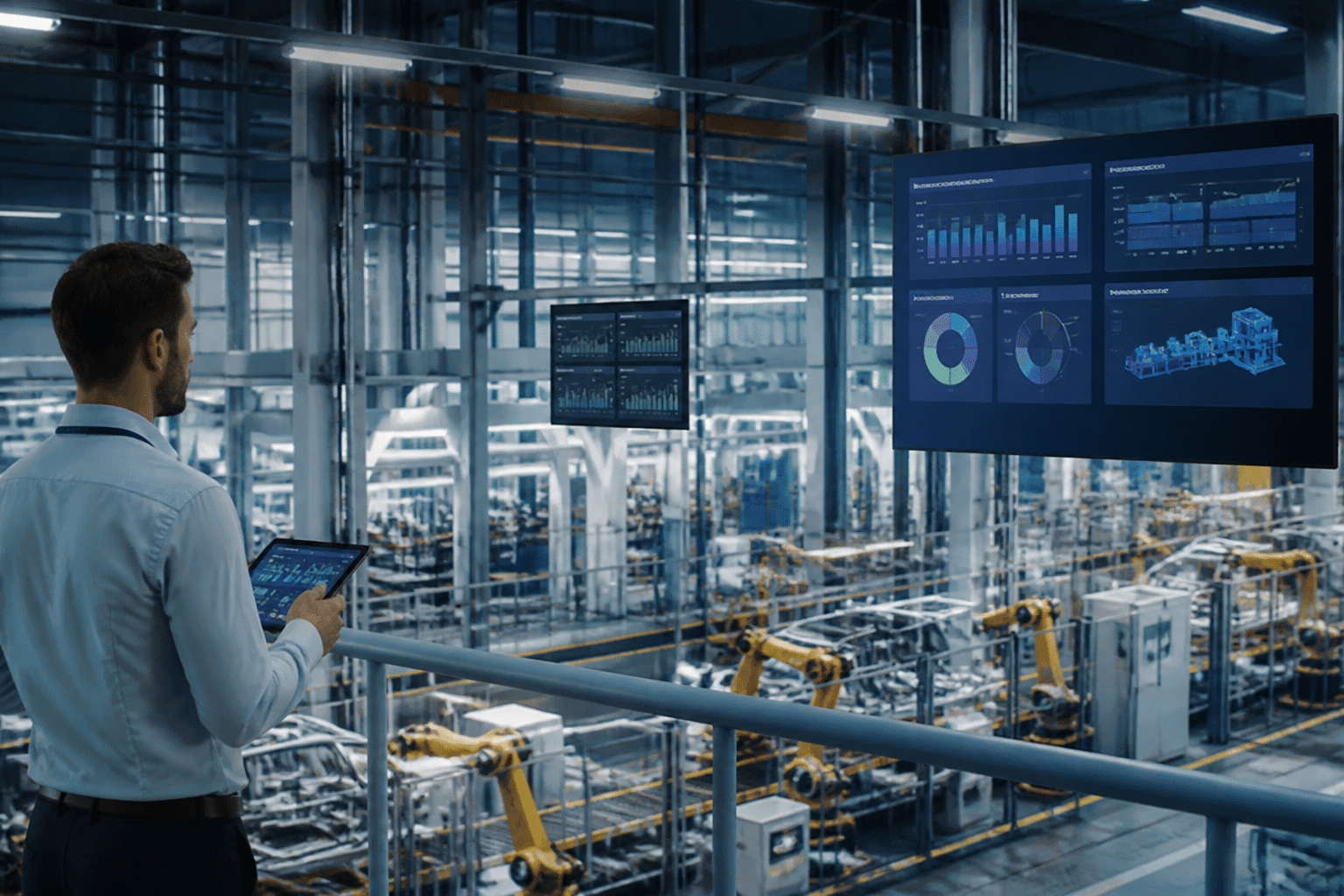
Even a tidy plan hits bumps. I'd rather you hear about them now than at 2am during cutover.
Here's the short version of the three that trip up most teams.
Problem | What it looks like | Fix that works |
|---|---|---|
Legacy constraints | Old PLCs and on-premise software that don't speak modern APIs | API wrappers or middleware around the old system |
Data governance and security | Duplicate part numbers, unclear owners, exposed plant networks | A data stewardship council plus segmented access |
Scalability | A rigid build that breaks when you add a plant or a tool | Cloud-native, microservices-based design |
Challenge 1: Legacy Systems That Won't Talk
That 15-year-old machine still makes money. Nobody wants to rip it out, and honestly, you probably shouldn't.
The trick is to leave it alone and build a translator next to it. An API wrapper puts a modern, standard interface on top of the old system, so your ERP software for manufacturing can ask for data without knowing how the machine thinks. Middleware does the same job for many systems at once, handling the format changes and retries in the middle.
Security matters here too. Keep brokers and APIs in a separate industrial zone, and don't point the cloud straight at a PLC. This is the kind of custom ERP integration work Buildera does around older equipment.
Challenge 2: Dirty Data and Open Doors
A single source of truth is only worth something if it's clean. Panorama Consulting's 2025 ERP Report found that data issues were the most common cause of schedule overruns. So this isn't a side problem. It's the problem.
My suggestion: set up a data stewardship council. Keep it small. Pull in people from IT, operations, quality, finance and supply chain. Give each core record (items, BOMs, routings, suppliers) one named owner, and write down which system wins when two disagree.
Worth knowing, too, that only 39% of manufacturing executives in CGI's 2025 research reported strong alignment between business and IT. A council fixes some of that by getting both sides in one room every month.
On security, Google's 2025 OT security blueprint points to three things working together: network monitoring, segmentation and role-based access. Add encrypted connections and a manual fallback, so a cloud outage never stops the line.
Challenge 3: Building Something That Can Grow
Here's a quiet trap. You wire every system together with hard-coded, point-to-point links, and it works great. Until plant number two. Or a new MES. Or an AI tool.
A cloud-native, microservices approach keeps each piece small and replaceable. Swap the scheduling module without touching finance. Add a site without rebuilding the pipes. Cloud ERP for manufacturing fits this pattern well, since new capabilities plug in through APIs instead of custom surgery.
One 2026 LTM case study shows the payoff of thinking ahead. The client folded ISAH, Dynamics AX 4.0 and Tally into Microsoft Dynamics 365 Finance and Operations, with a focus on shared processes and real-time financial visibility. It's consolidation, not pure integration, but the lesson holds: pick a design that can change.
So the hurdles are real, and every one has a known fix. Next, let's look at where all of this is heading.
6. The Future of Smart Manufacturing: AI, Cloud, and Hyper-Automation in Your ERP
Everything so far was about fixing today's mess. Now for the fun part.
Once your ERP talks to MES, sensors and supply chain tools, it stops being a record book. It becomes the data foundation for what's coming next. And that's where a partner with real AI and cloud experience, like Buildera, starts to matter.
AI Needs a Clean Hub First
Gartner points out that ERP is moving toward generative AI paired with predictive analytics and machine learning, all aimed at automating how work gets done. Sounds fancy. In practice, it means demand forecasts that shift with real orders and schedules that respect machine time, materials and labor. SAP's cloud ERP already offers demand simulations and lead-time prediction with automatic ordering triggers.
But go slowly. Deltek's 2026 ERP value analysis says AI in manufacturing is moving carefully, since advice has to respect compliance rules and physical limits. Smart. Keep a human approval step on anything that touches production.
Cloud-Native Means Plants Can Grow
With cloud ERP for manufacturing, a planner in Pune and a plant manager in Ohio look at the same live numbers. Remote monitoring gets simpler. Adding a site stops being a rebuild. That's the scalability we talked about in the last section, paying off.
Hyper-Automation Closes the Loop
Picture this. A sensor flags a worn bearing, the ERP reserves the part and books the work order, and an automated system moves the material to the right cell. No one retypes anything. Not every plant is there yet (most aren't), but the ERP is the piece that makes it possible.
Here's the hub-and-spoke view:
Spoke | What the ERP hub provides | What comes back |
|---|---|---|
AI and machine learning | Clean orders, BOMs, inventory and history | Forecasts, schedules, risk flags |
IoT | Asset records and maintenance rules | Live machine condition and alerts |
Automation and robotics | Approved work orders and priorities | Confirmed output and material moves |
So, with the vision set, what should you actually do on Monday? Let's wrap it up.
Conclusion: From Siloed Operations to a Cohesive Digital Enterprise
Here's the short version of everything above. Connecting your ERP software for manufacturing to the floor, the supply chain and your sensors isn't a nice upgrade anymore. It's how you grow, cut waste and stay steady when things shake.
The payoff comes in three pieces. You get full visibility, so nobody guesses what's on the shelf or what the line did overnight. You get faster, smarter calls, because the data is live and clean. And you get a base for whatever comes next, whether that's AI, new plants or tighter reporting. Deloitte's survey of 600 executives found that companies already running smart manufacturing reported 10% to 20% higher production output and up to 15% more unlocked capacity. That's a gap your rivals will happily widen.
So what's your first move? Don't rip anything out. Pick one flow, like order-to-production, and spend a week mapping where people still retype numbers. Set one baseline number, such as schedule adherence, and pilot one connection for 30 to 60 days. Small. Measurable. Real.
More broadly, stop treating your ERP as a standalone system. Start planning it as the digital core of the whole operation.
Natan Linder, CEO of Tulip, puts it well: "What truly matters now is continuous transformation, a mindset rooted in ongoing, adaptive change." That's the mindset.
You don't have to do it alone, though. Legacy machines, messy master data and security zones are tricky, and an experienced software engineering partner can save you months. If you'd like a second opinion on where your integration stands today, talk to the Buildera team and get a clear read on your next step.
Ready to build software that actually works for your business?
Free discovery call · 15 minutes · No obligation