Introduction: Why Modern Software Engineering Demands Agility
Ever watched a team spend six months building the “perfect” feature, only to hear, “Actually, we need something else now”? Yeah. That moment hurts.
That’s the big problem with old-school Waterfall planning in software engineering. It moves in a straight line. Plan. Build. Test. Ship. And if the business changes halfway through, the whole thing can get sticky fast. Real projects do change. Customers change. Markets change. Product goals change. Weirdly enough, the code is often the easiest part to change.
Agile software development was built for that mess. Not as a buzzword. As a mindset. It helps teams work in smaller steps, talk more, and adjust as they go. That means less waiting, fewer giant surprises, and better teamwork across the software development life cycle.
t up, too. In one recent ref project outcomes, Agile projects succeeded 42% of the time, while Waterfall only hit 13% success, with much higher failure rates for Waterfall overall Agile vs. Waterfall success rates. And adoption is huge. Most teams are already using Agile in some form, with Scrum, Kanban for developers, and even hybrid setups showing up everywhere.
So if you work in modern software engineering, this isn’t just theory. It’s daily work. In the sections ahead, we’ll break down Agile principles, the scrum framework, extreme programming (XP), continuous integration, and practical habits that make collaborative coding and software project management a lot less painful. Plus, we’ll keep it grounded in real life, not fluffy boardroom talk. Because nobody needs more of that.
If your team is trying to move faster without breaking things, you’re in the right place.

1. The Foundational Shift: From Rigid Plans to Agile Principles in Software Engineering
I once watched a team spend weeks polishing a plan chart that looked beautiful on a wall. Color-coded. Neat. Useless by month two.
That’s the trouble with Waterfall in software engineering. It moves in one straight line. First you plan. Then you build. Then you test. Then you ship. Sounds tidy, right? But real projects don’t stay tidy for long. A new market need pops up. A bug shows up late. A manager changes the goal. And now the whole chain feels slow and stiff.
The numbers back that up. One recent review found Agile projects succeeding 42% of the time, while Waterfall hit only 13% Agile vs. Waterfall success rates. So yeah, this isn’t just team drama. It changes results.
What Agile actually asks of a developer
Agile isn’t “do whatever you want.” It’s more like a set of habits that keep teams honest and moving.
The 4 core values are pretty simple:
People and teamwork over tools and rules
Talk to your team. Don’t hide behind tickets.
Working software over big documents
If the code runs and helps users, that beats a fancy slide deck.
Customer input over contract handcuffs
Feedback should shape the next step.
Changing plans over sticking to one fixed path
If the facts change, the plan should too.
And the 12 principles? A few stand out for daily software engineering work:
Deliver useful software early and often
Welcome changing requirements, even late
Keep a steady pace
Working software is progress
Clean code and good design help teams stay flexible
Face-to-face talk, or quick real-time talk, beats slow back-and-forth
Teams should reflect and improve often
That last one matters a lot. If we keep doing the same broken thing sprint after sprint, we’re not Agile. We’re just busy.
So what changes in practice?
A lot, actually. Agile principles push teams toward smaller releases, faster feedback, and tighter collaboration. That usually means better code quality because problems get caught sooner. It also helps speed to market, since you’re not waiting six months to learn you built the wrong thing.
And collaboration gets better too. Developers, testers, product people, and designers stay in the loop instead of tossing work over a wall. Less guessing. Fewer surprise meetings. More actual progress.
For teams modernizing old systems, this is where partners like Buildera can help. When you’re working on custom software development, legacy application modernization, or product engineering, Agile gives you a way to move without making a giant mess.
Here’s the blunt version: Waterfall likes certainty. Agile likes learning. And in software engineering, learning wins most days.

2. Deep Dive: The Scrum Framework and the Engineer's Role
Ever been in a team meeting where nobody seems to know what the next step is? Scrum was made for that kind of chaos.
It gives software engineering teams a simple rhythm. Not perfect. Just clear enough to keep work moving. And in practice, that rhythm usually feels a lot better than giant plans that sit in a slide deck for three months.
The main Scrum parts
Scrum has three roles:
Role | What they do |
|---|---|
Product Owner | Decides what matters most in the product backlog |
Scrum Master | Helps the team work well and removes blockers |
Development Team | Builds the software |
Then come the events:
Sprint: a short work cycle, often 1 to 4 weeks
Daily Stand-up: a quick check-in, usually 15 minutes
Sprint Review: the team shows what got done
Retrospective: the team talks about what went well and what didn’t
And the artifacts are the work lists:
Product Backlog: the full list of needed work
Sprint Backlog: the pieces chosen for this sprint
Simple, right? Well, mostly simple. The tricky part is how the team uses them.
What software engineers do in Scrum
If you’re a software engineer on a Scrum team, you’re not just coding in a corner. You help shape the work.
That usually means:
Estimating tasks before the sprint starts
Talking through user stories with the team
Joining stand-ups and giving real updates
Helping spot risks early
Working toward the sprint goal, not just your own tickets
Joining reviews and retrospectives with honest feedback
That last one matters. A lot. If the sprint review turns into a silent demo and the retro turns into “all good here,” then Scrum is just theater.
User stories and story points
User stories are small descriptions of what a user needs. They usually sound like this:
As a customer, I want to save my cart so I can come back later.
That keeps the team focused on real people, not just features floating around in a backlog. Pretty handy.
Story points are a way to estimate size. Not time, exactly. More like effort, complexity, and risk all mixed together. A 2-point story is usually smaller than an 8-point story, but the number itself doesn’t mean hours. That’s the whole point.
Teams often use story points to compare work and plan sprints without pretending they can predict every minute. Because honestly, software engineering doesn’t work that neatly. One bug fix can take 20 minutes. Another can eat half your day and a coffee refill.
For teams using agile software development, Scrum works best when people speak up early and keep the feedback loop tight. That’s where collaborative coding and software project management start to feel a lot less painful.
And if your team is modernizing old systems or building new products, Buildera can help with custom software development, product engineering, and legacy application modernization while keeping the process grounded in real delivery, not process fluff.
If you want a better sprint next week, start with one thing: make the goal clear, then protect it.
3. An Alternative Flow: Understanding Kanban for Continuous Delivery
Ever had five urgent bugs hit at once, plus two new feature requests, and one exec asking, “Can we get this done by Friday?” Yeah. Kanban was basically built for weeks like that.
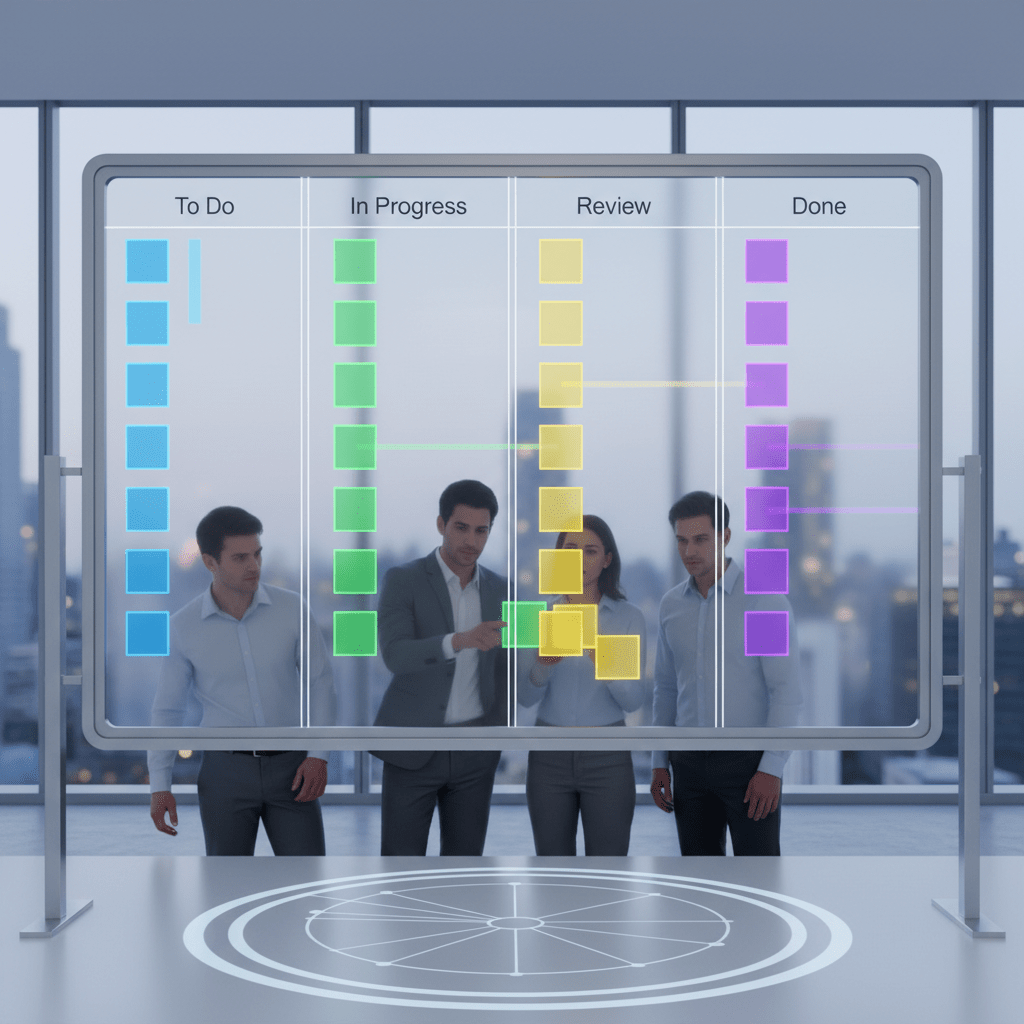
Where Scrum gives teams a steady sprint rhythm, Kanban gives you a smooth flow. It’s a visual way to manage work as it moves from one stage to the next. No fixed sprint calendar. No set roles you must follow. Just a simple idea: see the work, limit how much you start, and keep things moving.
That makes Kanban for developers a really nice fit for support teams, ops teams, and product groups with messy, changing workloads. If your queue changes every day, Kanban can feel like a breath of fresh air. Less ceremony. More motion.
The pieces that make Kanban work
Each task gets a card. A card might be a bug fix, a small feature, or even a support ticket. You move the card across the board as the work moves ahead. Nice and simple.
Then there’s WIP, which means Work In Progress. That’s the part many teams miss at first. WIP limits cap how many items can sit in a column at once. So if “In Progress” already has 4 cards, maybe nobody starts a fifth until one leaves. Sounds strict? Maybe. But it stops teams from juggling too much at once, which usually helps speed and focus.
Why Kanban feels different from Scrum
Here’s the big split: Scrum runs in sprints. Kanban doesn’t need them. Scrum also comes with set roles like Scrum Master and Product Owner. Kanban doesn’t ask for that structure unless your team wants it.
So if you work in software engineering where requests show up out of nowhere, Kanban often fits better. Think customer support, platform ops, and maintenance teams. The work keeps coming, and the team needs a way to handle it without waiting for the next sprint to begin.
And honestly, that’s where Kanban shines. It gives you a clear picture of flow. You can spot bottlenecks fast. If cards keep piling up in review, well, there’s your clue. No mystery novel needed.
Teams using modern software engineering practices often pair Kanban with metrics like cycle time and lead time. That helps them see how long work really takes from start to finish. If you’re modernizing older systems or trying to cut down delays, Buildera can help with custom software development, product engineering, and legacy application modernization while keeping delivery steady and practical.
Kanban won’t solve every problem. But for unpredictable work, it’s pretty hard to beat.
4. Engineering-Focused Agility: Extreme Programming (XP) and Other Frameworks
You know that moment when the code works... but nobody trusts it yet? That’s usually where XP starts to make sense.
Extreme Programming, or XP, is a software engineering approach that puts technical habits front and center. It’s not about big meetings or fancy charts. It’s about writing better code, checking it often, and keeping the team close enough to catch problems early. Kent Beck, who helped shape XP, put it pretty plainly: “XP is a discipline of software development based on values of simplicity, communication, feedback, and courage.”
That line hits hard. Because in real projects, courage usually means deleting half-baked code, asking for feedback sooner, and not pretending a shaky feature is “done.”
XP practices developers actually feel
A few XP habits show up a lot in daily software engineering work:
Role | What they do |
|---|---|
Product Owner | Decides what matters most in the product backlog |
Scrum Master | Helps the team work well and removes blockers |
Development Team | Builds the software |
TDD can feel slow at first. But it catches bugs before they spread. Pair programming can feel a little awkward too, at least on day one. Then it starts paying off. One study from Laurie Williams found pair programming produced about 15% fewer defects while taking only about 15% more developer time. That’s a trade I’d take most days.
And CI is the glue. If you’re merging code once a week, you’re asking for a mess. If you’re using GitHub Actions, GitLab CI, or Jenkins to test every change, you spot problems while they’re still small. That’s just easier on everybody.
A couple of cousins of XP
Lean Software Development is about removing waste. Stuff like extra features nobody asked for, waiting, handoffs, and rework. Basically, all the stuff that makes teams groan at 4:30 on a Friday.
Crystal is a bit different. It cares a lot about people, team size, and communication. Smaller teams usually need less ceremony. Bigger teams need clearer habits. Simple idea. Good fit for teams that want agility without a ton of rules.
So if Scrum gives you structure and Kanban gives you flow, XP gives you muscle. It helps teams keep code healthy while shipping in short cycles. And for companies modernizing older systems, that mix can be a lifesaver.
Buildera often helps teams put these modern software engineering practices into real projects through custom software development, product engineering, and legacy application modernization. If your codebase feels a little dusty, this is a good place to start. Small steps. Better habits. Less drama.
5. The Agile Engineer's Toolkit: Essential Practices and Skills
You know that weird moment when a feature looks done, but you still don’t trust it? Yeah. That’s usually a sign the team needs better habits, not more meetings.
In software engineering, Agile is not just about stand-ups and sticky notes. It changes the day-to-day work too. The best teams use small, steady practices that keep code healthy while the product keeps moving.
The daily habits that make Agile work
A few technical habits show up again and again in solid Agile software development teams:
Practice | What it helps with |
|---|---|
Test-Driven Development (TDD) | Catches bugs early by writing tests first |
Continuous Integration (CI) | Finds broken code fast when changes are merged often |
Refactoring | Keeps code clean and easier to change |
Code reviews | Shares knowledge and spots problems sooner |
TDD can feel slow the first time you try it. Then, a week later, it saves you from a tiny bug turning into a full-blown mess. That’s the trade. And honestly, it’s a pretty good one.
CI works the same way. If your team uses GitHub Actions, GitLab CI, or Jenkins, every push can get checked right away. Build. Test. Scan. Repeat. Nothing fancy. Just fewer surprises. That matters a lot in the software development life cycle, where one bad merge can wreck a whole sprint.
Don’t let technical debt pile up
Refactoring is the part people skip when deadlines get loud. Big mistake. Tiny code fixes, done often, keep the codebase from turning into a haunted house of old shortcuts and “temporary” hacks that never left.
There’s a simple rule I like here: leave the code a little cleaner than you found it. One small edit. One renamed function. One removed duplicate block. It adds up fast.
And the best Agile teams keep asking, “Can we make this easier next time?” Not just, “Did it ship?” That shift helps avoid technical debt, which is basically tomorrow’s headache wearing today’s outfit.
The human side matters too
Here’s the thing though. Agile doesn’t only reward strong coders. It also rewards people who can talk clearly, listen well, and give feedback without making it weird.
That means:
Speaking up early when something feels off
Giving code review notes that help, not sting
Asking questions instead of guessing
Working as a group, not as solo heroes
Collaborative coding gets better when people feel safe enough to say, “I’m not sure this is right.” That sentence can save hours. Maybe days.
And in sprint reviews or retrospectives, honesty matters more than polish. If a build keeps failing, say it. If the estimate was way off, say that too. No drama. Just facts.
A lot of teams also pair these habits with stronger software project management, because good process without good communication still falls apart. Buildera often helps teams build these modern software engineering practices into custom software development, product engineering, and legacy application modernization work. If your team needs help making Agile feel real instead of performative, that kind of support can make a big difference.
So if you’re trying to level up as a software engineer, don’t just learn the framework names. Learn the tiny habits that make them work.
Small tests. Clean code. Clear talk. Better builds. That’s the toolkit.
Conclusion: Embracing Agility as a Career-Long Practice
Agile is not just a process list. It’s a way of working that puts people, teamwork, and real value first. And in software engineering, that shift changes a lot.
We saw it across the whole article. Waterfall can look neat on paper, but the real world keeps moving. Agile software development gives teams a better shot at keeping up, and the numbers are hard to ignore. One review found Agile projects succeeded 42% of the time, while Waterfall hit only 13% Agile vs. Waterfall success rates. That’s a big gap.
But the bigger win is day-to-day work. Better talks. Faster feedback. Cleaner code. Less guesswork. More trust. Plus, when you keep using modern software engineering practices like Scrum, Kanban for developers, XP, and continuous integration, you get better at the craft itself. That helps your career too. You become the person who can work well with others, ship useful things, and adjust fast when plans change.
And honestly, that’s the real edge. Not being the loudest coder in the room. Being the one who helps the team move.
If you want one small next step, try this: bring a 15-minute daily stand-up to your team this week. Keep it short. Keep it honest. Or, if your group already does stand-ups, read the Agile Manifesto with your coworkers and pick one principle to improve next sprint. Small move. Real progress. That’s how Agile sticks.
Ready to build software that actually works for your business?
Free discovery call · 15 minutes · No obligation