
Why Future-Proofing Your Business Starts with Your Software Strategy
Have you ever opened a tool you paid for and thought, “Wait... this is supposed to help us grow?” Yeah, same. A lot of off-the-shelf software works fine at first, but it can start to feel cramped fast when your business changes, your team grows, or your customers want more than the basics.
That’s the big shift right now. Software is not just a helper anymore. It’s becoming the thing that helps companies move faster, serve people better, and stand out. The market for custom software is growing fast too, with one report placing it at about $43 to $53 billion in 2024 to 2025 and expecting it to hit $146.18 billion by 2030 Grand View Research.
And this is why the right custom software development company matters so much. The goal here isn’t just to build apps. It’s to build a software plan that can keep up with new tech, changing customer needs, and real business goals. We’ll look at the key trends in custom software development services, from AI in software development to composable architecture, so you can have a smarter talk with your software development partner.
Because honestly, software is no longer just a tool. It’s part of the business engine now. And if your system can’t grow with you, it can slow you down. Fast.

Trend 1: Hyper-Automation Fueled by AI and Machine Learning
You know that moment when a task used to take all afternoon, and now it takes five minutes? That’s where AI is heading inside custom software development services. Not just chatbots. Not just search boxes. I’m talking about the stuff that runs the business day to day.
A smart custom software development company can build AI in software development right into core workflows. That means predictive analytics that spots churn before a customer walks away. It means intelligent process automation that handles repeat work without making your team babysit every step. And yes, it can mean hyper-personalization too, like a CRM that changes follow-up timing based on how people actually behave.
Actually, wait. There’s a better way to think about it. AI is moving from “nice extra” to “quiet helper in the engine room.”
Here’s the cool part. Generative AI can also speed up the build itself. A software development partner can use tools like TensorFlow, PyTorch, Hugging Face Transformers, LangChain, and OpenAI APIs to help with coding, test case creation, and even early UI/UX ideas. So the team spends less time on grunt work and more time on the tricky stuff that really needs human judgment.
That’s a big deal for companies choosing a software development firm. Why? Because the ROI can be real. Some custom AI builds report 150% to 600% ROI over three years, plus faster response times and lower back-office costs, according to Helium42.
A few examples make this easier to picture:
Business need | Custom AI/ML example | What it can do |
Sales team losing leads | CRM churn prediction | Flags at-risk customers early |
Messy inventory | Retail ML planning | Balances stock before shelves go empty |
Fraud problems | Real-time fraud model | Spots risky transactions fast |
Slow supply chain | ERP with ML forecasts | Adjusts supply flow as conditions change |
Bradesco in Brazil used a custom AI credit decision system that automated 95% of credit analyses and cut decision time from days to minutes IBM. That’s the kind of shift people feel right away.
And if you’re talking with Radixweb or any other custom software development company, this is the time to ask how they handle model training, data quality, testing, and ongoing tuning. Because AI that looks smart in a demo can get messy fast in real life. Especially with older systems. Especially with bad data. You get the idea.
So don’t just ask, “Do you build AI?” Ask, “How does AI help my business logic, and how do we keep it useful after launch?” That’s the better question.

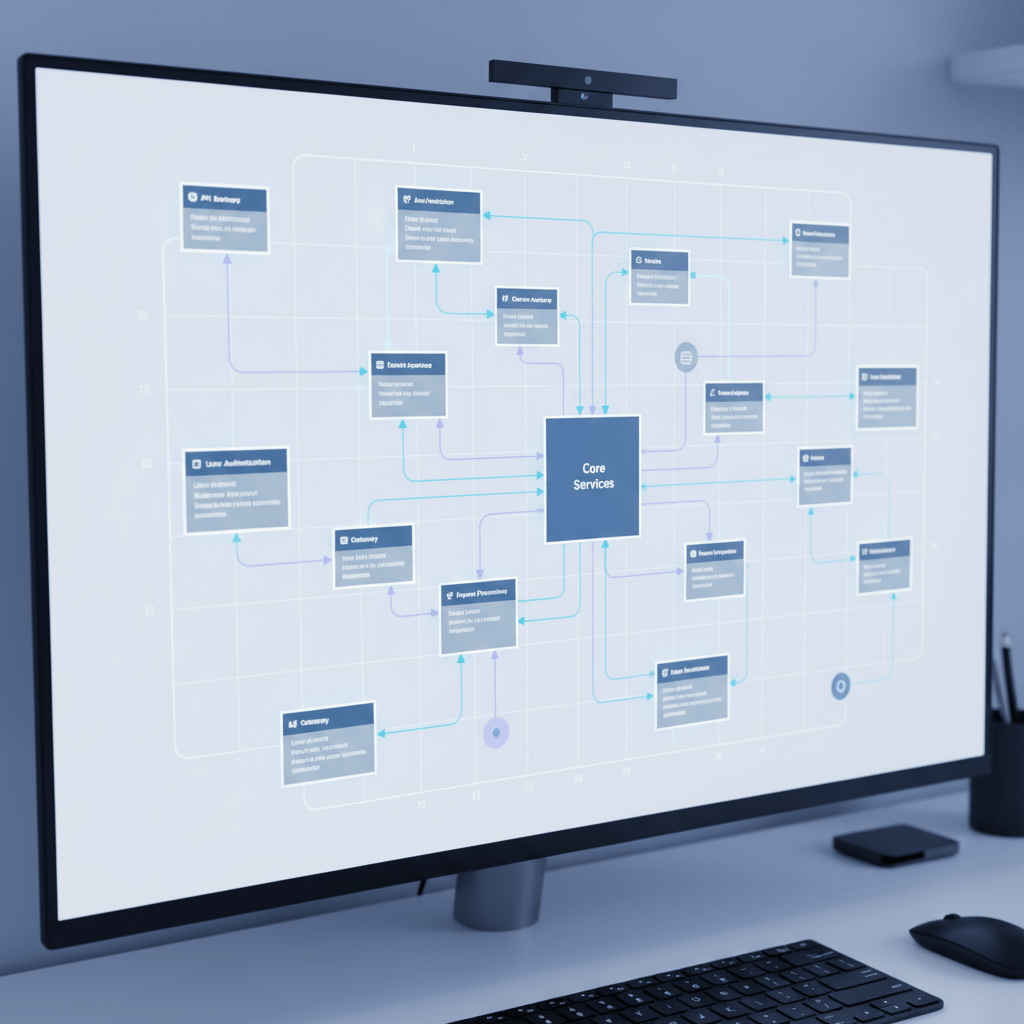
Trend 2: Composable Architecture and Microservices Over Monoliths
Ever tried to update one tiny thing in a giant old app and somehow broke three other things? Yep. Been there. That’s the pain of a monolith.
A monolith is one big block of software. One codebase. One giant build. If you change one part, the whole thing can feel shaky. Composable architecture and microservices take a different path. They split the system into smaller parts, so each piece can do its own job without dragging the whole app down.
That matters a lot for a custom software development company helping a growing business. Why? Because your needs won’t stay still. You might need a new checkout flow next month, a new customer portal later, and a faster mobile experience after that. With a composable setup, your software development partner can swap in best-fit pieces, custom-built or third-party, without tearing everything apart.
Think of it like LEGO blocks instead of one poured concrete slab. Same idea, less mess.
Here’s the deal:
Setup | Simple idea | Business upside |
Monolith | One big app | Easier at the start, but harder to change later |
Microservices | Small services working together | Easier to scale and update pieces one at a time |
Composable architecture | Mix of custom and third-party parts | More flexibility and faster feature changes |
The big wins are pretty clear. You can scale only the parts that need it. You can ship new features faster. And if one service has a bad day, the whole app doesn’t have to crash and burn. Nice, right?
Netflix is the classic example here. It moved from one monolithic app to hundreds of microservices and cut deployment time from weeks to minutes. That kind of change doesn’t happen by accident. It takes planning, strong DevOps habits, and a software development partner that knows how to keep the pieces talking to each other.
And yes, there are trade-offs. More services means more moving parts, more monitoring, and more care around data and testing. But for many companies, that extra effort is worth it because the future of software engineering is leaning toward systems that can change as fast as the business does.
If you’re choosing a software development firm, ask how they handle service boundaries, APIs, and long-term support. That’s where composable architecture either shines... or gets messy real fast.
Trend 3: The Strategic Use of Low-Code/No-Code (LCNC) Platforms
You know that feeling when a team says, “We just need this one small app,” and six weeks later it’s suddenly a full-blown project? Yeah. LCNC can help with that mess.
A lot of people hear low-code or no-code and think, “Oh no, will this replace developers?” Not really. At least not in the smart setup. A good custom software development company usually uses LCNC to handle the smaller, faster jobs so developers can focus on the hard stuff. The custom parts. The weird edge cases. The stuff that actually moves the business forward.
Here’s the thing. LCNC works well for rapid prototypes, internal dashboards, simple approval flows, and non-critical pieces inside a bigger custom software system. So if your team needs a quick portal for HR requests or a basic ops tool for tracking tickets, a software development partner can often build that much faster with LCNC than by starting from zero.
And then there’s the “citizen developer” piece. That just means business users who build simple apps with help from IT. Pretty handy, right? But it only works well with guardrails. The IT team still needs to watch security, data access, and integrations so things don’t get messy later. Because once five departments start building their own little tools, you can end up with a mini software zoo.
LCNC can be a bridge between teams. Business gets speed. Tech keeps control. That balance matters more as digital transformation stays at the top of the list for many companies, even though plenty of those projects still miss the mark McKinsey and BCG research on transformation failure.
If you’re choosing a software development firm, ask how they use LCNC without creating hidden risk. That one question tells you a lot.
Trend 4: Cybersecurity by Design & DevSecOps
Ever had that weird feeling after a software launch? The one where everything looks fine on the surface, but you still wonder, “Did we miss something?” Yeah. That feeling gets louder when security was left for later.
That’s why more teams are moving from reactive security to security by design. In plain words, they’re building protection into the software from day one, not bolting it on after the first scare. And DevSecOps is the work style that helps make that happen. It’s not a buzzword. It’s a habit.
Here’s what that looks like in real life:
Security step | What it means | Why it helps |
Threat modeling | Thinking through attack paths during design | Finds weak spots early |
Automated security tests | Running scans in the CI/CD pipeline | Catches issues before release |
Continuous monitoring | Watching systems after launch | Spots trouble fast |
A custom software development company with real DevSecOps skills can help you avoid the stuff nobody wants to deal with later. Data leaks. Surprise downtime. Compliance headaches. The average cost of a data breach hit $4.44 million in 2025, and the U.S. average was even higher at $10.22 million IBM’s 2025 breach report summary. That’s not pocket change. That’s boardroom stuff.
So when you’re choosing a software development firm, ask how they handle security at each step. Do they use SAST, DAST, SCA, secrets scanning, and container checks? Do they bake security reviews into design? Do they keep an eye on runtime behavior after launch? If the answer is fuzzy, that’s a red flag.
And yes, this matters for compliance too. If you handle healthcare or personal data, you need to think about HIPAA and GDPR from the start, not after a scary email from legal. A good software development partner helps you keep privacy, access control, and audit trails in the same plan as the product itself.
Look, I get it. Security can feel like the part that slows things down. But the better way to think about it is this: safe systems move faster because they break less. And when your custom software development services are built with security from the start, your team spends less time putting out fires and more time shipping work that actually helps the business.
Trend 5: Progressive Web Apps and One Smooth Experience Across Devices
Ever tap a site on your phone and think, “Why does this feel like a half-finished app?” Yeah. People notice that stuff fast. And they leave just as fast.
That’s why Progressive Web Apps, or PWAs, are getting so much attention in custom software development services. A PWA is a web app that acts more like a mobile app. It can load fast, work offline, send push notifications, and sit on a home screen like a real app. Pretty handy.
For a custom software development company, that means one build can go a long way. Instead of making separate native apps for iPhone and Android, teams can often use cross-platform frameworks like React Native or Flutter, or go with a PWA for lighter needs. That usually means less maintenance, fewer code piles, and a lower bill at the end. Not bad.
The business case is pretty clear. Building two native apps can cost anywhere from $150K to $500K and take 6 to 9 months, while a PWA may land around $30K to $100K and take 6 to 8 weeks. That’s a big gap. And people do use them. Twitter Lite, for example, saw a 75% jump in tweets sent after its PWA launch, while Starbucks made its web ordering much lighter and easier for users on the go PWA case studies and results.
Here’s the part that matters most: users want the same smooth feel on desktop, tablet, and mobile. No weird jumps. No clunky refreshes. No “sorry, that feature only works on one device” nonsense. A good software development partner can help you decide if a PWA, Flutter, React Native, or a full custom app makes the most sense for your audience and your budget.
So if you’re talking with Radixweb or any other custom software development company, ask this simple question: do our users need separate apps, or do they just need one great experience everywhere? That answer can save a lot of time, money, and head-scratching later.
How to Evaluate and Choose a Future-Ready Custom Software Development Company
You can spot a good software partner pretty fast. They don’t just nod and say “yes” to everything. They ask hard questions. They poke at your plan a little. That’s a good sign.
The reason this matters is simple. The custom software market is growing fast, from about $43 billion to $53 billion in 2024 to 2025, and it’s expected to hit $146.18 billion by 2030 Grand View Research. So if you’re choosing a custom software development company now, you’re not just buying code. You’re picking a long-term software development partner.
And that choice gets even bigger because digital change is still a huge priority for business leaders, even though lots of projects miss the mark. So the right fit is not only about technical skill. It’s about business thinking, clear communication, and a team that can keep up as your needs change.
Quick checklist: what should you ask?
Use this like a real conversation guide, not a script.
Question to ask | What a strong answer sounds like |
What is your experience with AI/ML integration? | Clear examples, real data needs, and how they test models over time |
Show us your DevSecOps process. | Security steps in design, build, testing, and launch |
How do you handle composable architecture or microservices? | Specific service boundaries, API planning, and monitoring plans |
What have you built with low-code or no-code tools? | Smart use of LCNC for speed, with guardrails from IT |
How do you measure success after launch? | Business results, not just delivered features |
Look past the shiny demo
A nice portfolio is fine. But a pretty app screenshot doesn’t tell you much. Ask to see case studies with real outcomes. Did the software cut manual work? Did it speed up orders? Did it help a sales team close more deals? Those are the numbers that matter.
A strong custom software development company should also be able to explain why they chose a certain path. For example, if they built a PWA instead of separate mobile apps, they should tell you the trade-offs. If they used AI in software development, they should explain the data, the model, and the business result. If they used composable architecture, they should tell you how they handled scaling and service gaps.
That kind of talk shows maturity. And honestly, it saves headaches later.
Red flags that usually mean trouble
They won’t give you a named project lead.
They only talk about tech, not your business goals.
Their timeline sounds too good to be true.
They say yes to every request without pushback.
Their case studies have logos, but no results.
They can’t explain how they handle security or QA.
And here’s a big one. If they don’t ask you questions, that’s weird. A good software development firm should want to know your users, your revenue goals, your weak spots, and your future plans. If they don’t, they’re probably treating this like a one-off build instead of a real partnership.
Ask for the business thinking, not just the build plan
Radixweb, for example, works across custom software development services, product engineering, legacy modernization, and IT consulting. That mix matters because future-ready work often touches more than one layer of the business. You might need old systems cleaned up, a new app built, and a security plan that holds up under pressure. One team should be able to connect those dots.
I’d also ask this: do they challenge your assumptions? A solid software development partner won’t just repeat your idea back to you. They might say, “Actually, a PWA could fit better than native apps,” or “This part should be low-code, but this part should stay custom.” That kind of pushback is helpful. It usually means they’re thinking about your outcome, not just the invoice.
A simple way to compare vendors
Try scoring each company on these five things:
Business understanding
Technical depth
Security habits
Flexibility of delivery model
Proof of real results
If one vendor looks great on slides but weak on outcomes, keep looking. And if another one asks smart questions, shares honest trade-offs, and brings ideas you hadn’t thought of, that’s usually the better bet.
The future of software engineering belongs to teams that can build, adapt, and keep learning. So when you’re choosing a software development firm, don’t just ask who can code. Ask who can think with you.
Building Tomorrow’s Success on Today’s Technology Choices
So here’s the big takeaway: AI, composable architecture, low-code tools, DevSecOps, and PWAs are not separate trends sitting in neat little boxes. They work together. They help a business move faster, stay safer, and change without falling apart every time the market shifts.
The custom software development company you pick should do more than write code. It should act like a software development partner that helps you make smart calls, not just fast ones. That matters even more now, since the custom software market is growing from about $43 billion to $53 billion in 2024 to 2025 and is on track to hit $146.18 billion by 2030 Grand View Research.
And that growth isn’t happening by accident. Businesses want better ways to work, but a lot of digital change projects still miss the mark. So the real win is choosing a team that can connect emerging tech in software development with your actual business goals.
If you’re ready to talk with Radixweb or another custom software development company, start with one simple question: which of these trends solves our biggest headache first? That’s the conversation worth having.
Ready to build software that actually works for your business?
Free discovery call · 15 minutes · No obligation