
Why Your Technology Stack Is More Than a Technicality—It's a Business Decision
I’ve seen smart teams spend months on the wrong build, and the sad part is it usually starts with one small choice. The stack. That one choice can shape speed, cost, hiring, and how much pain you’ll feel later.
And the numbers are rough. In the Standish Group CHAOS Report, only 29.7% of software projects were fully successful in 2023, while 21.1% failed outright and 49.2% were challenged, meaning late, over budget, or missing scope. That’s a lot of lost time, money, and sleep.
So no, choosing your tech stack is not just a nerdy setup task. It’s a long-term business call that affects how fast you can launch, how much it costs to keep the system running, and whether the software can grow with you.
A bad pick can slow delivery, create rework, and lock your team into a messy setup that gets harder to change every year. A good one gives you room to grow without making every update feel like a fire drill.
What this guide is here to do
We’re going to walk through a simple way to think about technology stack selection for custom software projects. Not hype. Not buzzwords. Just a clear way to weigh trade-offs.
You’ll see how different choices affect architecture, budget, and team fit. You’ll also see why many companies lean on an experienced custom software development company or software development partner to help them build custom software the right way from day one.
Actually, scratch that. The goal is even bigger than picking tools. It’s about choosing a foundation that supports enterprise software development, keeps maintenance from eating your budget, and gives your product a fair shot at success.
If you’re staring at a blank board and thinking, “React, Django, Node, AWS... where do we even start?” you’re in the right place.

Choosing Your Tech Stack: A Strategic Guide for Custom Software Projects
Why Your Technology Stack Is More Than a Technicality—It's a Business Decision
I’ve seen smart teams spend months on the wrong build, and the sad part is it usually starts with one small choice. The stack. That one choice can shape speed, cost, hiring, and how much pain you’ll feel later.
And the numbers are rough. In the Standish Group CHAOS Report, only 29.7% of software projects were fully successful in 2023, while 21.1% failed outright and 49.2% were challenged, meaning late, over budget, or missing scope. That’s a lot of lost time, money, and sleep.
So no, choosing your tech stack is not just a nerdy setup task. It’s a long-term business call that affects how fast you can launch, how much it costs to keep the system running, and whether the software can grow with you.
A bad pick can slow delivery, create rework, and lock your team into a messy setup that gets harder to change every year. A good one gives you room to grow without making every update feel like a fire drill.
What this guide is here to do
We’re going to walk through a simple way to think about technology stack selection for custom software projects. Not hype. Not buzzwords. Just a clear way to weigh trade-offs.
You’ll see how different choices affect architecture, budget, and team fit. You’ll also see why many companies lean on an experienced custom software development company or software development partner to help them build custom software the right way from day one.
Actually, scratch that. The goal is even bigger than picking tools. It’s about choosing a foundation that supports enterprise software development, keeps maintenance from eating your budget, and gives your product a fair shot at success.
If you’re staring at a blank board and thinking, “React, Django, Node, AWS... where do we even start?” you’re in the right place.
Deconstructing the Tech Stack: The Core Components Explained
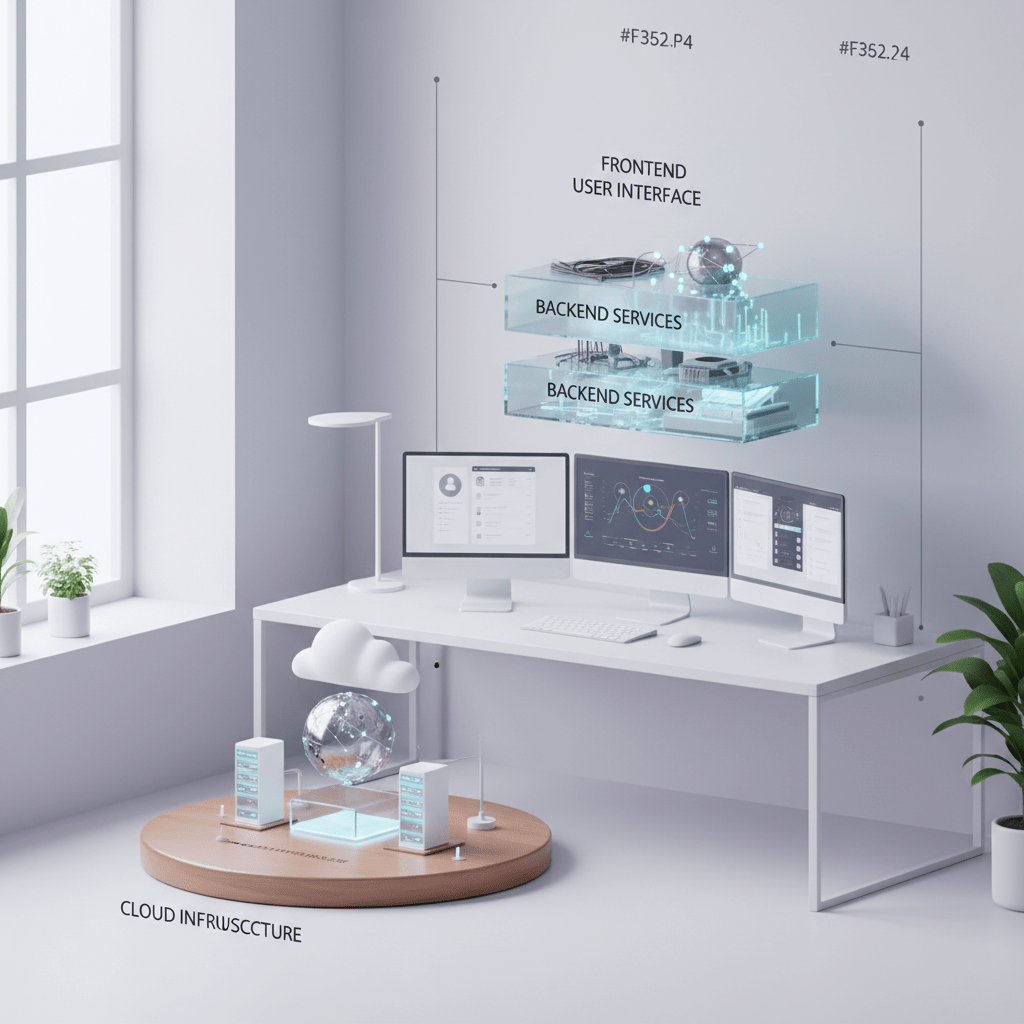
Think of a tech stack like building a house. The frontend is the paint, windows, and rooms people walk through. The backend is the wiring and plumbing behind the walls. The database is the storage closet where everything lives. And infrastructure is the land, power, and tools that keep the whole place standing.
Simple? Yep. But each part changes the others.
If you choose a big, flashy frontend but pair it with a weak backend, the app feels slow. If your database can’t keep up, the whole house starts creaking. And if your infrastructure can’t scale, you’ll feel it the first time traffic jumps on launch day.
Here’s the basic breakdown:
Layer | What it does | Common choices |
Frontend | What users see and click | React, Angular, Vue, Svelte |
Backend | Handles rules, logic, and requests | Node.js, Python, Java, C# |
Database | Stores data | PostgreSQL, MySQL, MongoDB |
Infrastructure | Runs and ships the app | AWS, Docker, Kubernetes, CI/CD tools |
The frontend talks to the backend through an API. That’s just a shared doorway. The backend then reads from or writes to the database, while infrastructure keeps everything live, secure, and moving through deployment pipelines.
And this part matters more than people think. A stack choice in one layer can box you in somewhere else. For example, a team that wants fast product updates may pick React with Node.js because the same language, JavaScript, can run through much of the system. But if the app needs heavy data work, Python or Java might fit better in the backend.
That’s why technology stack selection is never just about what looks popular. It’s about choosing the mix that fits your custom software projects, your team, and the kind of scalable software architecture you want later.
If you’re not sure where to start, a good technology consulting services team can help you compare options without turning the process into a guessing game. And honestly, that can save you from a lot of expensive second-guessing later.
The 7 Critical Factors for Your Technology Stack Selection
Choosing a tech stack sounds simple until you’re the one stuck with it. Then it’s a whole different story. I’ve seen teams pick fast, shiny tools and pay for it later with slow releases, messy handoffs, and a lot of “why did we do this?” meetings.
So let’s make this easier.
There is no magic stack that fits every project. Not for custom software projects. Not for enterprise software development. The right choice is the one that fits your goals, your team, and the kind of software you’re trying to build custom software around.
Here are the seven factors I’d look at first.
1. Project requirements
Start here. Always.
What are you actually building? A simple customer portal? A data-heavy dashboard? A real-time marketplace? The more moving parts you have, the more your stack choice matters.
Ask yourself:
What features do we need on day one?
What parts are must-haves, and what can wait?
Do we need real-time updates, lots of reports, or heavy data work?
Will this app talk to other systems right away?
A startup MVP and a healthcare platform are not the same job. Not even close. A custom software development company should be asking about workflows, users, and edge cases before it talks frameworks. If they start with tools first, that’s a red flag.
2. Scalability needs
This one trips people up.
You might only have 500 users now. Cool. But what happens if you hit 50,000 next year? Or 1,000,000 in two years? That’s where scalable software architecture starts to matter.
Ask:
Will we need to handle 1,000 users or 1,000,000 users in two years?
Will traffic spike at certain times?
Do we need to scale parts of the system separately?
Can this stack grow without a full rebuild?
Twitter’s early “Fail Whale” days are a pretty loud reminder of what happens when growth outruns the stack. The product got famous fast, but the setup couldn’t keep up, and outages became part of the brand. Nobody wants that kind of fame.
3. Team expertise and talent pool
This is the part people skip because it feels less exciting. But it’s huge.
If your team knows Python well, forcing them into a niche stack can slow everything down. And if you need to hire later, a tiny talent pool can make recruiting painful and expensive.
Ask:
What does our team already know well?
Can we hire for this stack in our market?
Will we need outside help from a software development partner?
How much training time can we afford?
From what I’ve seen, a stack that fits your people usually beats a “better” stack that nobody can support. Usually. There are exceptions, sure, but they’re rarer than people think.
4. Total cost of ownership
This one gets ignored because the upfront price looks fine. Then year two shows up. And year three. Oof.
TCO means more than just build cost. It includes hosting, licenses, maintenance, security patches, developer time, and upgrades. Open-source tools can save money at the start, but they may cost more in internal upkeep. Proprietary tools may have higher fees, but they sometimes come with support and easier upgrades.
Ask:
What will this cost to build, run, and maintain?
Are there license fees or per-user charges?
How much staff time will patching and support take?
What’s the cost if we need to replace it later?
A lot of software teams focus on day-one cost. But maintenance often eats most of the lifetime budget. So yes, the cheap option can turn pricey fast.
5. Time-to-market
Speed matters. A lot.
If you need to launch in 90 days, you probably don’t want a stack that takes six months just to set up. On the flip side, going too fast with the wrong base can slow you down later. So it’s a balance.
Ask:
How fast do we need to launch?
Does this stack help us ship an MVP sooner?
Are the tools easy for the team to work with?
Will we spend more time building or untangling setup?
This is where teams often lean on technology consulting services or a custom software development company to sort out the trade-offs. A good partner can help you move fast without building a pile of future problems.
6. Security and compliance
If your software handles health, money, customer data, or anything regulated, don’t treat security like a bonus round.
Some stacks make secure development easier because they have stronger defaults, better auth tools, or clearer update paths. Others need more manual work. And if you’re in healthcare, fintech, or retail with sensitive data, compliance can shape everything.
Ask:
What data will we store?
Do we need HIPAA, PCI DSS, GDPR, or other rules?
How do this stack’s tools handle auth, logging, and patching?
Can we prove the system is secure when auditors ask?
Short version: if your stack makes security harder, you’ll feel that pain every week.
7. Ecosystem and community support
A stack is more than code. It’s the people, docs, plugins, and fixes around it.
If a tool has a strong community, you can usually find answers faster. More tutorials. More libraries. More developers who’ve already hit the same weird bug you’re seeing at 11:42 p.m. on a Thursday.
Ask:
Is this stack widely used?
Are there active docs, plugins, and updates?
Will we be stuck if one vendor drops support?
Can our team find help without too much pain?
This is one reason popular choices like React, Node.js, PostgreSQL, and AWS keep showing up in custom software projects. They’re not the only answers, but they’ve got depth behind them.
A quick way to compare stack choices
Here’s a simple view you can use in planning meetings:
Factor | Ask yourself | Why it matters |
Project requirements | What are we building? | Sets the shape of the whole system |
Scalability needs | Will usage grow fast? | Helps avoid rebuilds later |
Team expertise | What does our team know? | Affects speed and hiring |
Total cost of ownership | What will it cost over time? | Keeps surprise bills down |
Time-to-market | How fast do we need to ship? | Impacts launch timing |
Security and compliance | What rules do we need to meet? | Protects data and trust |
Ecosystem support | Can people help us fast? | Lowers risk and delays |

So what’s the real takeaway?
Pick the stack that fits the business, not the one that sounds smartest in a meeting.
That’s the whole game. You’re balancing speed, cost, talent, growth, and risk. Sometimes you’ll choose the simpler stack because the team needs to ship now. Sometimes you’ll choose the heavier one because long-term scale matters more. That trade-off is normal.
And if you’re not sure which side to lean toward, that’s a good time to talk with a custom software development company that works on product engineering, modernization, and IT consulting. The right partner won’t just hand you a tool list. They’ll help you think through the mess before it turns into one.
No one-size-fits-all answer here. Just smart choices, one layer at a time.
An Overview of Popular Tech Stacks and Their Use Cases
OK, this is the part where theory turns real.
You can talk about technology stack selection all day, but at some point you need to ask, “What stack actually fits this project?” And that’s where things get a lot clearer. Or messier. Usually both.
Here are a few common stacks you’ll hear about in custom software projects, plus where each one tends to shine.
Tech stack | Parts | Strengths | Weak spots | Best fit |
MERN | MongoDB, Express, React, Node.js | One JavaScript language across most of the app, fast builds, good for real-time work | Can get tangled at scale, MongoDB is not always the best for strict data rules | MVPs, dashboards, chat apps, real-time products |
LAMP | Linux, Apache, MySQL, PHP | Cheap hosting, steady and proven, solid for content-heavy sites | Feels older, PHP can be a bit fragmented | CMS sites, blogs, traditional web apps |
Python + Django | Python, Django, often PostgreSQL | Fast to build, strong security defaults, great admin tools | Can be overkill for tiny apps | Internal tools, APIs, data-heavy apps |
Ruby on Rails | Ruby, Rails, often PostgreSQL | Very quick to ship, great for small teams, strong conventions | Can need more tuning as traffic grows | Startups, SaaS tools, marketplaces |
MEAN / modern TypeScript stack | MongoDB, Express, Angular, Node.js, often TypeScript | Good structure, lots of enterprise use, strong for large frontends | Angular can feel heavy for small teams | Enterprise apps, admin systems, large teams |
MERN: fast and familiar
MERN is a favorite for a reason. React on the front, Node.js on the back, and JavaScript almost everywhere. That can make hiring easier and code reviews smoother, since people are not switching languages every five minutes. Nice, right?
It works well for MVPs, single-page apps, and real-time products like live dashboards or chat tools. But here’s the catch. If the app gets really complex, a team needs strong rules or things can get sloppy fast. Also, Node.js is not the best pick for heavy number crunching.
LAMP: old school, still useful
LAMP has been around forever, and yeah, that’s actually a compliment.
It’s a steady choice for content management systems, marketing sites, and basic business apps. WordPress still lives in this neighborhood. The upside is low hosting cost and a huge amount of support online. The downside is that it can feel less modern, and PHP projects sometimes end up looking like they were built in three different eras (because they were).
Python + Django: clean and practical
If your team cares about speed, security defaults, and data work, Python plus Django is a strong pick. It’s popular for internal tools, analytics-heavy products, and systems with lots of forms or rules.
Django gives you a lot out of the box, which can save time. That said, it’s not always the lightest choice for a tiny product with very simple needs. But for many custom software projects, that extra structure is a relief, not a burden.
Ruby on Rails: built for quick moves
Rails is still a great fit for teams that want to move fast without writing a ton of setup code. It’s a strong match for SaaS products, startup apps, and marketplaces where the team wants to test ideas quickly.
The trade-off is scale tuning. At a certain point, you may need more work to keep performance smooth. Still, if you want to build custom software and get feedback early, Rails can be a very smart call.
A quick reality check
No stack is magic. Really. None.
A good custom software development company will not just say, “MERN is hot” or “Django is safe.” It’ll ask what you’re building, how fast you need to ship, who’s on the team, and whether the system needs scalable software architecture from day one. That’s the part that saves pain later.
And if you’re comparing a few paths, a software development partner like Radixweb can help you sort the choices without making it feel like a coin toss. Their work in custom software development, product engineering, and IT consulting is the kind of support teams often need when the stack decision has long-term business weight.
If you want to keep going, the next step is simple: map your product goals to one or two stack options, then test them against cost, hiring, and growth. That’s where the real decision gets made.## The Role of a Custom Software Development Company in Tech Stack Selection
You know that moment when a team says, “We just need to pick a framework”? That’s usually where the trouble starts. The truth is, a good custom software development company does a lot more than write code. It acts like a guide, a second set of eyes, and sometimes the voice that says, “Wait, that stack might look nice, but it’ll hurt you later.”
That matters because bad tech choices can get expensive fast. Poor stack picks often lead to delivery delays, extra rework, and long-term systems that are hard to grow. In one recent update on IT project outcomes, only 29.7% of software projects were fully successful, while 21.1% failed outright and 49.2% were challenged in some way. Those are rough odds if you’re guessing your way through technology stack selection research on IT project failure rates.
A strong software development partner helps you avoid that mess by starting with a discovery phase or tech audit. This is where they look at your business goals, users, data, risks, and growth plans before they suggest a tool. Good teams map out things like scope, user flows, integration points, security needs, and a rough roadmap. Not just “what’s trendy.” That’s the difference between random tool picking and real product thinking.
And here’s the part many teams miss. Cross-industry experience is a big deal. A team that has worked across healthcare, retail, real estate, and SaaS has probably seen the same stack choice succeed in one setting and fall apart in another. That kind of pattern spotting helps with scalable software architecture, because the answer is rarely about the fanciest tool. It’s about fit.
They can also help with hiring headaches. Niche tech can sound smart in a meeting, but it can be a pain to hire for later. A software development partner with its own expert teams can fill skill gaps right away, which keeps your build moving while you sort out long-term hiring. Handy. Very handy.
Here’s a simple way to think about the value they bring:
What they do | Why it helps |
Run discovery or a tech audit | Connects business goals to the right stack |
Review scalability early | Helps future-proof the product |
Spot risk before build starts | Cuts surprises, delays, and rework |
Bring expert teams | Solves niche hiring gaps faster |
Guide architecture choices | Supports enterprise software development over time |
So if you’re choosing a stack for custom software projects, don’t look for a vendor who just says yes. Look for a partner who asks better questions, pushes back when needed, and helps you build custom software that can actually grow with the business. That’s where the real value is.
Common Mistakes to Avoid When Choosing Your Tech Stack
You can pick a stack that looks smart on a slide deck and still end up with a mess. I’ve seen it happen. Fast.
1. Picking tech because it’s trendy
This is the classic resume-driven move. A team hears about the hottest framework and jumps in before asking if it fits the product.
To avoid trends, anchor the choice in your core business goals and user needs. If the tool does not help you ship faster, scale better, or support your team, skip it.
2. Ignoring long-term maintenance
A stack can feel cheap at first. Then the upkeep bill shows up. Patches, upgrades, bug fixes, and hosting can eat a big chunk of your budget over time.
A quick rule: ask what this will cost in year three, not just month one. And if your team keeps saying, “We’ll deal with that later,” well... later usually gets expensive.
3. Forgetting the talent pool
Fancy tech is fun until you need to hire for it. If only a few people know the stack, recruiting can get slow and pricey.
Choose something your team can already support, or something you can hire for without a long wait. A strong software development partner or custom software development company can help fill skill gaps, but you still want a stack people can grow with.
4. Optimizing too early
Some teams spend weeks making the system perfect for traffic they don’t have yet. That’s a pretty fast way to miss launch dates.
Build for today’s real needs first, then plan for growth. If you’re not at scale yet, don’t act like you are.
A simple gut check
Before you lock anything in, ask:
Does this help the business?
Can we hire for it?
Can we keep it running without pain?
Will it still fit when the product grows?
If the answer to any of those is shaky, pause. That’s the moment to bring in technology consulting services or a custom software development company that can pressure-test the choice before you build custom software around it.
And yes, that little pause can save months of cleanup later.
Building Your Future: Making a Confident Tech Stack Decision
So here’s the big takeaway: your tech stack is not just code. It’s a business bet.
The best choice sits right in the middle of business goals, user needs, and what your team can actually support. Not the flashiest tool. Not the loudest opinion in the room. The one that fits.
Quick reminder, too. Check the seven factors before you lock in anything:
Project requirements
Scalability needs
Team expertise
Total cost of ownership
Time-to-market
Security and compliance
Ecosystem support
Miss one of those, and the whole thing can wobble later. And nobody wants that kind of surprise after launch.
If you’re still unsure, that’s normal. Really. This is exactly where a trusted technology consulting services team or a seasoned custom software development company can help you test the choice before you build around it. Radixweb works with teams that need custom software development, product engineering, and enterprise software development support, so they can sanity-check the stack against real business needs.
That kind of second opinion can save you from rework, delays, and a pile of technical debt. Worth it, probably.
Pick with care. Build with purpose.

Ready to build software that actually works for your business?
Free discovery call · 15 minutes · No obligation