
38% of DevOps and platform migrations delivered less ROI than promised to executives and boards.
That's from a survey of 300+ enterprise IT leaders, in the 2025 DevOps Migration Index.
That number stings. Most teams already did the hard part. They set up pipelines, automated builds, and started shipping faster. And still, the payoff didn't show up.
Here's the thing. DevOps isn't going anywhere. Forrester put it bluntly in its 2025 DevOps Platforms analysis: "Despite claims that 'DevOps is dead,' the truth is that DevOps is everywhere." But being everywhere is different from being good at it.
Basic CI/CD used to be the finish line. Now it's more like the starting block. The future of software development is shifting toward built-in security, AI-driven operations, internal developer platforms, and a clear line from every code change to a business result. Skip that next step, and technical debt quietly piles up while faster competitors pull ahead.
So what changes? Less focus on tools, honestly. More focus on how security, AI, and business value fit together. That's hard to pull off alone, especially with a stretched engineering team and a legacy system nobody wants to touch.
That's why choosing the right devops development company matters so much. In this guide, we'll look at the trends shaping what's next, then walk through how to pick a partner who can actually help you get there. Firms like Buildera see this pattern all the time, so we'll share what to look for.
Beyond Automation: Redefining DevOps as a Core Business Strategy

Picture a release day. Developers hand code to operations. Operations blame the code. Business folks wait, and nobody's sure why it took six weeks. We've all seen some version of that.
That's what DevOps was built to fix. And no, it's not just a pile of CI/CD tools.
DevOps Is a Culture First, a Toolset Second
Modern DevOps is a way of working. Developers, operations, security, and business teams share the same goals and the same problems. No more throwing work over a wall. When something breaks at 2am, it's everyone's problem, and everyone learns from it.
The loop looks like this:
Step | The question it answers |
|---|---|
Idea | What does the customer need? |
Development | How do we build it in small, safe pieces? |
Operations | How do we run it and keep it healthy? |
Customer feedback | Did it actually help? |
Back to the idea | What should we improve next? |
It never really stops. That's the point.
From Cost Center to Value Driver
Here's where it gets interesting for leaders. Faster pipelines are nice, but the real prize is business results: quicker time-to-market, smoother operations, and better products. If your DevOps work can't point to one of those, something's off.
Kaiser Permanente is a good example. According to InformationWeek's report on its DevOps shift, the healthcare giant paired a new pipeline with a product-centric operating model, so work was organized around products with clear business purposes. Tools alone didn't do that. (The story dates from 2017, but the lesson holds up.)
So the question changes. Instead of "how many deployments did we ship?" you ask "what did those releases do for customers and revenue?" That's the difference between IT as a line item and IT as a growth engine.
Next, let's look at the trends pushing this thinking even further.
4 Key Trends Shaping the Future of DevOps
So where is DevOps actually headed? Four shifts stand out, and if you're a CTO or IT Director, they're worth planning for now.
These aren't fads. Each one exists because DevOps hit a wall. Security checks slow releases down. Alerts pile up faster than anyone can read them. Tool sprawl makes every new hire's first month painful. And leaders still can't see how code turns into revenue.
Here's a quick preview of what's coming:
Trend | The problem it solves |
|---|---|
DevSecOps | Security slowing teams down |
Too many alerts, too little insight | |
Platform engineering | Tool sprawl and heavy complexity |
Value stream management | No clear line from code to business results |
We'll take them one at a time, starting with security.
1. DevSecOps: Integrating Security as a Foundational Layer

Picture a house that's fully built. Then someone says, "Let's add the locks and smoke alarms." Awkward, right? And expensive.
That's how many teams still treat security. They ship first and check later. DevSecOps flips that. It's the practice of "shifting left," which just means moving security checks earlier in the process and running them automatically through the whole software lifecycle.
Bolted-On vs. Built-In Security
Here's the difference side by side:
When it happens | Right before release | From design through production |
Who owns it | A separate security team | Developers, ops, and security together |
How it runs | Manual reviews and long checklists | Automated checks in the pipeline |
What happens when it finds a problem | Release stalls for days or weeks | Developer gets feedback in minutes |
Cost of a fix | High, because code is already live or nearly so | Lower, because the code is still fresh |
Notice the last row. That one matters most to the business.
Why Leaders Should Care
Money is the loudest reason. IBM's 2025 Cost of a Data Breach report puts the global average breach at $4.44 million. Teams that used AI and security automation heavily saved about $1.9 million per breach and cut the breach timeline by roughly 80 days. That's real money and real time.
But it's not only about avoiding disasters. Built-in checks also keep audits calmer, since compliance evidence gets collected as you go instead of during a panicked scramble. And releases don't slow down, because the checks run while the pipeline runs.
A fintech example makes this concrete. Solaris worked with Cycode to centralize its security findings, and Cycode's case study reports a 61% drop in time to fix high-risk issues. Triage time fell from 3.1 days to under 60 minutes. (It's a vendor-published result, so treat it as a strong example, not a guarantee.)
What It Looks Like in Practice
Start at the whiteboard. Threat modeling in the design phase means your team asks, "How could someone break this?" before writing a single line. It's cheap, and it catches design flaws that no scanner will ever find.
Then the pipeline takes over. Here are the main checkpoints:
Pipeline stage | Security check | Example tool |
|---|---|---|
Design | Threat modeling | Team workshop |
Commit | Secrets detection | Gitleaks |
Build | SAST (scans source code) and dependency checks | Semgrep, Trivy |
Infrastructure changes | Config scanning | Checkov |
Staging | DAST (tests the running app) | OWASP ZAP |
The tools matter less than the rule behind them: critical findings should block a release, not just show up in a report nobody reads.
This is where the right partner earns their keep. A good devops development company, like Buildera, will wire these checks into your existing pipeline and keep them friendly for developers. Next up: what happens when the alerts start piling up.
2. AIOps: Leveraging AI for Predictive Insights and Proactive Operations
You know that 3am page where 400 alerts fire at once? And nobody can tell which one actually matters? That's the problem AIOps goes after.
AIOps means using AI and machine learning to run IT operations. It watches your systems, spots patterns, and helps your team respond. Think of it as a very patient co-worker who never sleeps and reads every log line.
Why Complex Systems Need It
A few servers were easy to watch. Now you've got microservices on the cloud, containers spinning up and down, and dozens of tools all sending data. No human can keep up with that. Not really.
The result is a lot of operational overhead. Your best engineers spend their days chasing noise instead of building things. Sound familiar?
The interest is real, too. An EMA and BigPanda survey of IT operations leaders found that 100% of respondents put more automation, AI, and AIOps among their top two goals for the next six to 18 months. That's not a small crowd.
Three Things AIOps Actually Does
Here's where it gets practical.
Predicts failures. It learns what "normal" looks like, then flags odd trends (like a disk filling up faster than usual) before users feel anything.
Finds the root cause. Instead of your team hunting through logs, it connects the dots across services and points to the likely culprit. That cuts Mean Time to Resolution (MTTR), which is how long it takes to fix an issue.
Cuts alert noise. It groups duplicate and low-value alerts into one clear incident. Some reports say noise can drop by as much as 90%.
Traditional Monitoring vs. AIOps
Alerting | Fixed thresholds, lots of duplicates | Grouped, ranked alerts that show what matters |
Root cause analysis | Engineers search logs by hand | Automatic correlation across services |
Remediation | Manual fixes after users complain | Suggested or automated fixes, often before impact |
Overall approach | Reactive | Proactive |
What Results Can You Expect?
Reports vary, so treat these as ranges, not promises. Studies often link AIOps to 40 to 60% lower MTTR, and some show gains in app availability too. Your mileage will depend on how clean your data is and how well the tools fit your setup.
That last part matters most. Platforms like Dynatrace, Datadog, and PagerDuty are good, but they only help if they plug into your CI/CD pipeline, cloud setup, and ticketing system. A devops development company such as Buildera can help pick the right AIOps solutions and connect them to what you already run.
Once operations are smarter, the next question is how developers get a smoother path to production.
3. Platform Engineering: Building Paved Roads for Developers
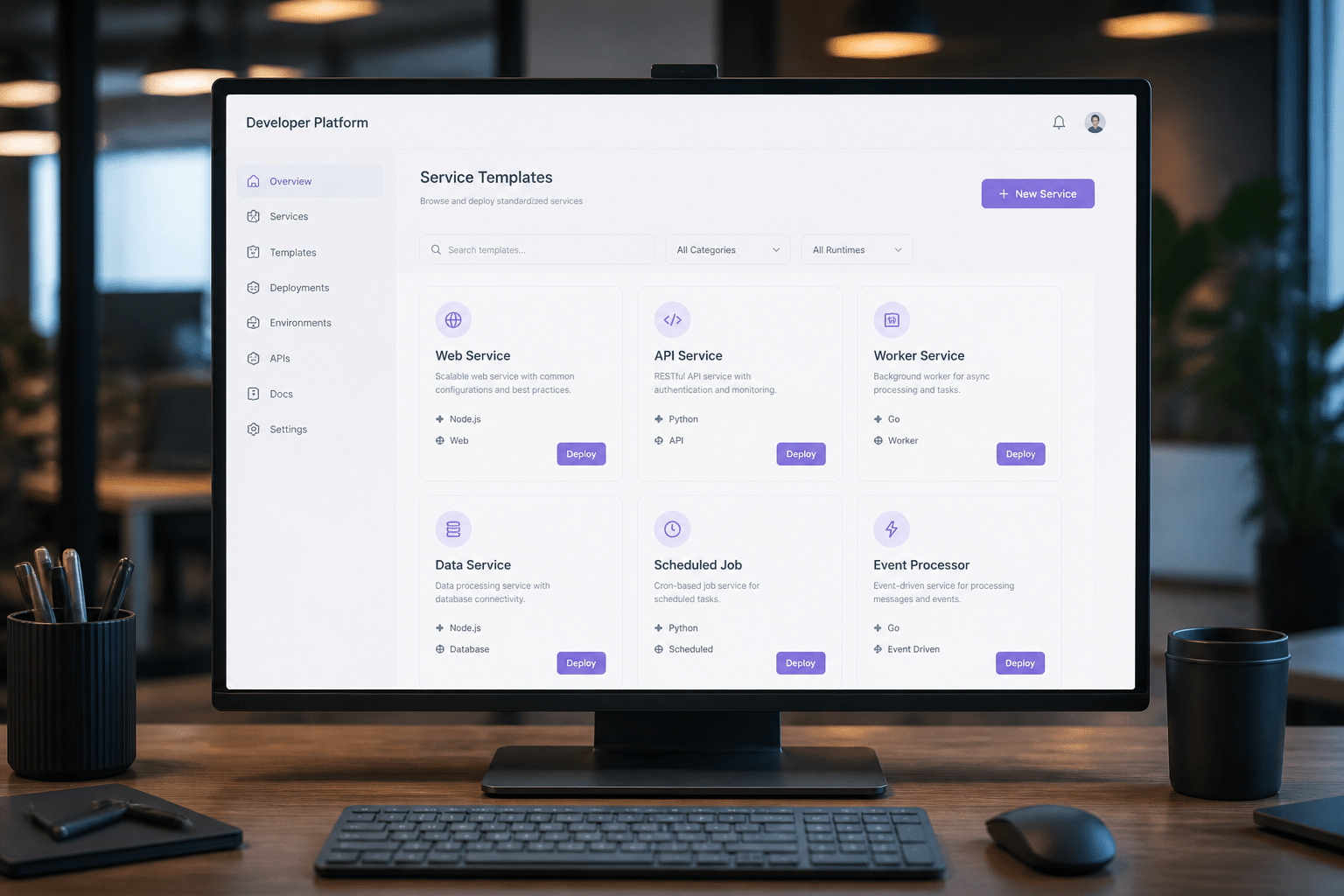
Ever started a new job and spent your first three weeks just asking, "Where do I find that?" Yeah. Me too. Now picture that pain across 200 developers, every single week.
That's the mess platform engineering tries to clean up. Over the years, DevOps teams added more tools, more clouds, more scripts. Each one made sense on its own. Together? A maze.
What Platform Engineering Actually Is
Platform engineering is the practice of building and running an Internal Developer Platform, or IDP. Think of it as a product your own engineers use. Its customers are your developers, and its job is to make their day easier.
Gartner expects that 80% of large software engineering organizations will have platform engineering teams by 2026, up from 45% in 2022. That's a fast jump. So this isn't some side project anymore.
Here's how the "paved road" idea works in plain terms:
Layer | What developers see | What the platform handles behind the scenes |
|---|---|---|
Self-service portal | A simple menu of approved templates | Standard setups for services, apps, and data jobs |
Infrastructure | A button to get a new environment | Cloud resources, Kubernetes, databases |
CI/CD | A ready pipeline from day one | Builds, tests, and deployments |
Security | Feedback inside pull requests | Secrets handling, scans, and policy checks |
Observability | Dashboards tied to their service | Logs, metrics, alerts, and ownership info |
Developers stay on the road. The platform team keeps the road smooth.
Why It Helps With the Talent Crunch
Good engineers are hard to find and even harder to keep. So you can't afford to waste their brainpower on cloud setup questions. An IDP cuts what folks call cognitive load, which is just the pile of stuff a developer has to hold in their head to ship one change.
Spotify is the classic example. Its Golden Paths gave engineers ready-made templates, and according to Spotify's engineering team, the time to get a basic service running dropped from 14 days to under 5 minutes. Wow. Fourteen days to five minutes.
For a stretched team, that's like hiring extra people without posting a job ad. New hires get productive faster, too, since the road is already paved.
So Do You Still Need DevOps Engineers?
Yes. Absolutely.
This trend doesn't erase DevOps engineers. It changes what they do. Instead of answering the same ticket for the 40th time, they build the platform that hundreds of developers use on their own. Their work becomes a multiplier.
That shift takes real skill, though. A platform nobody wants to use is just another tool nobody asked for. Good DevOps consulting services and a partner like Buildera can help you decide what belongs on the paved road first, then build it around how your developers actually work.
With the platform in place, one question is left: are all these improvements paying off for the business?
4. Value Stream Management (VSM): Connecting Technical Work to Business Outcomes
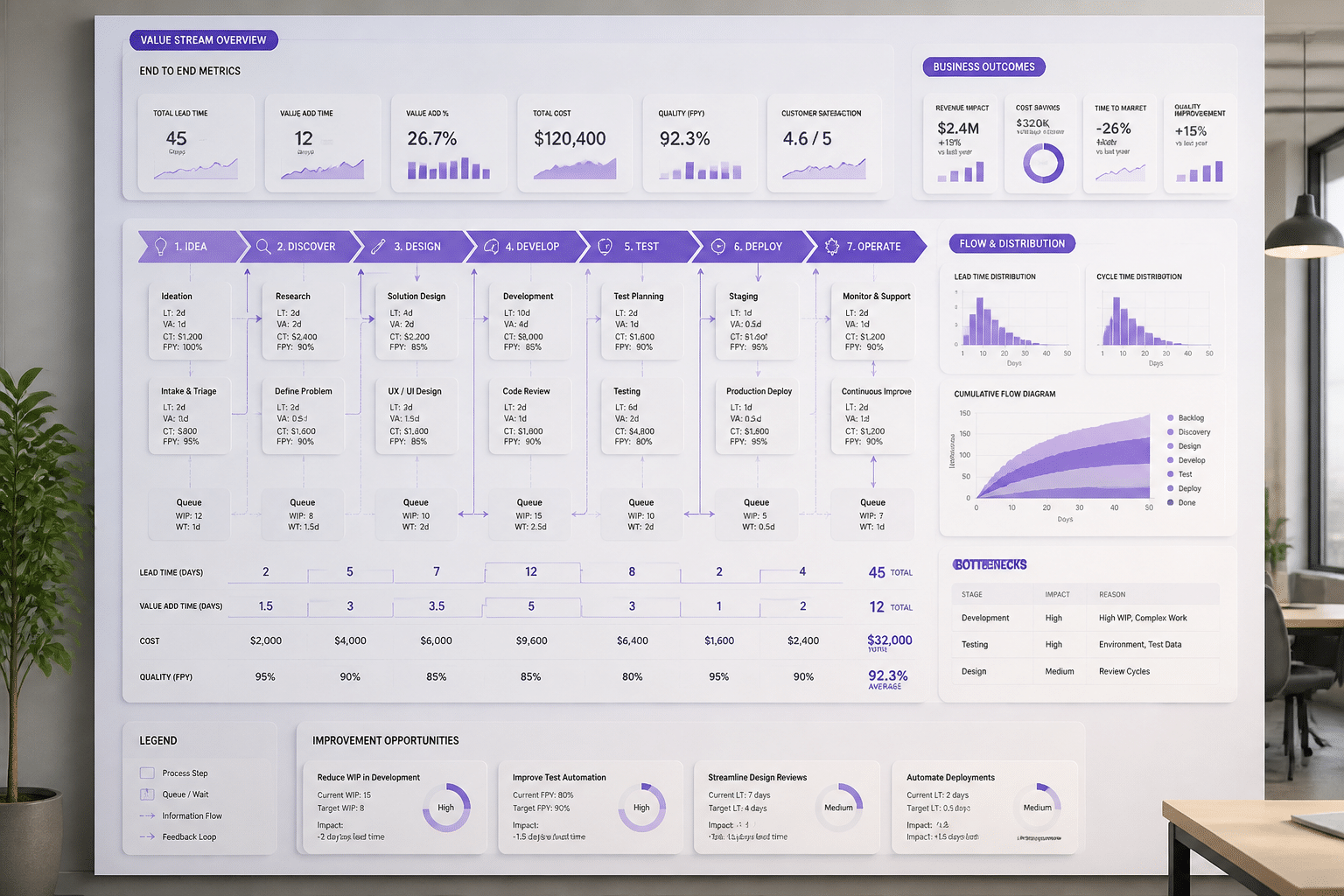
Picture this. Your platform is paved, your alerts are quiet, and a small feature still takes 11 weeks to reach customers. Where did the time go?
That's the question Value Stream Management, or VSM, answers. It gives you a clear view of the whole software delivery process, from the first idea to the moment a customer actually gets value. Not just the pipeline. The whole trip.
Where Work Gets Stuck
Here's a simple value stream, with the spots where time tends to leak out:
Stage | What happens | Where waste often hides |
|---|---|---|
Idea and approval | A request is reviewed and ranked | Long waits in the backlog |
Planning | Requirements get clear | Rework from vague specs |
Build | Developers write code | Too many tasks open at once |
Review and test | Code is checked | Waiting for reviewers or test environments |
Release | Changes go live | Manual approvals and change boards |
Customer use | People try the feature | Features nobody ends up using |
In a lot of teams, the waiting takes longer than the working. You can't fix what you can't see, and VSM makes the waiting visible.
Three Numbers Worth Watching
You don't need a dozen metrics. Start with these:
Lead time: how long it takes from a customer request to a working release.
Cycle time: how long work takes once someone actually starts it.
Flow efficiency: the share of time work is being worked on, instead of sitting in a queue. If a task takes 20 days but only 2 days involve real effort, that's 10%. Ouch.
These numbers help answer two big questions. Are we building the right thing? And how can we deliver value faster? The first one needs customer data next to your delivery data. The second one needs flow data. VSM brings both to one place.
Why Leaders Should Care
For CTOs and Product Managers, VSM turns opinions into evidence. Instead of guessing why releases feel slow, you can point to the exact handoff that's eating two weeks. It also keeps engineering effort tied to strategy, so the team isn't polishing a feature the business stopped caring about last quarter.
The interest is growing, too. One Grand View Research market analysis estimated the global VSM market at $480.5 million in 2024, with a 9.8% yearly growth rate expected from 2025 to 2030.
One warning, though. Many companies treat VSM like a dashboard project. They draw a pretty map, connect the tools, and then nobody owns the fixes. Broadcom's VSM guidance suggests a better path: line up value with strategy, start small, and improve step by step using data.
That's where an experienced devops development company like Buildera can help. Pick one important product, set baselines, and prove the value before rolling it out everywhere.
So the trends are clear. Now let's talk about how to pick a partner who can help you act on them.
How to Choose the Right DevOps Development Company for the Future
You've seen where DevOps is heading. Security built in, smarter operations, paved roads for developers, and a clear line to business results. Great. But knowing the "what" is the easy part.
The harder question is who helps you actually get there.
Look for a Partner, Not Just a Vendor
A vendor takes a ticket and closes it. A true IT consulting firm asks why the ticket exists in the first place. That difference sounds small. It isn't.
Remember, DevOps is a culture first and a toolset second. So the company you hire has to work with your people, your habits, and your messy legacy systems, not around them. If they can't explain your business problem in plain words, they probably can't fix it either.
This is the space where Buildera works. It's a custom software engineering and IT consulting firm, so the focus is on strategy, modernization, and long-term fit, not just handing over a pile of pipelines.
The Partner Evaluation Checklist
Use this table when you compare shortlisted companies. Print it out if that helps. I would.
Criteria | What to look for |
|---|---|
Expertise in cloud-native and AI | Real production work on Kubernetes, major cloud platforms, and AIOps solutions that plug into your existing tools |
DevSecOps implementation proof | Automated security checks inside pipelines, with critical findings that block releases and metrics like time to fix |
Platform engineering mindset | They treat an internal platform like a product, and they can explain how they'd pick what goes on the paved road first |
Proven VSM experience | A habit of setting baselines, starting with one product, and tracking lead time and flow efficiency |
Complex modernization portfolio | Named projects with legacy systems, similar scale, and results you can verify with a reference |
Cultural fit | Clear communication, shared goals, and respect for how your team already works |
Knowledge transfer | Runbooks, workshops, and a handoff plan so you never get stuck depending on them |
No partner will be perfect on every row. But if a company is weak on three or four, keep looking.
Questions to Ask and Red Flags to Watch
Good questions cut through sales talk fast. Ask for baseline and target metrics, such as deployment frequency and lead time. "Faster delivery" without a number doesn't count. Also ask to meet the actual engineers, and consider a paid discovery or pilot before signing a long contract.
A small start tells you a lot. MobiDev, for example, says it audited a troubled codebase in three days, fixed two severe issues, and produced a roadmap. That's the kind of diagnose-first approach you want to see.
And the red flags? A few show up again and again:
They lead with tools before they understand your problem.
They can't share references from similar projects.
Nobody talks about what happens after launch.
The sales team is the only group you ever meet.
One more thing. Trust your gut on the vibe. If the conversation feels like a lecture, imagine six months of it.
Once you know what a strong partner looks like, the last step is deciding how to move forward with confidence.
Partnering for Tomorrow: Embrace the Future of DevOps with Confidence
Let's wrap this up. We covered a lot, but the story is pretty simple.
DevSecOps builds security in from the start. AIOps cuts through the alert noise. Platform engineering paves the road for your developers. And value stream management shows whether all that work is paying off. Together, they're not a wish list of shiny tools. They're a strategic must-have for any company that wants to keep shipping well in the years ahead.
The gap between teams that get this right and teams that don't is already measurable. According to the 2024 DORA research, elite performers deploy 182 times more often than low performers. That's not a small edge. It's a different league.
Now, can you do all of this alone? Maybe, if you have a deep bench of engineers with spare time. Most teams don't. Between legacy systems, hiring pressure, and roadmaps that never shrink, it's tough to build security pipelines, smarter operations, and an internal platform on the side. That's where the right devops development company earns its place. Someone who's done it before can help you skip the expensive detours.
Buildera is a custom software engineering and IT consulting firm that works with CTOs, CIOs, and IT Directors on exactly this kind of shift. The approach starts with your goals, not a tool list. What's slowing you down? What would a good result look like in 90 days? Then you build a practical plan from there.
So here's a simple next step. Don't try to fix everything at once. Get an honest look at where you stand today, pick one or two areas that would move the needle, and go from there.
Ready to see where your DevOps maturity really stands?
Talk with the Buildera team about your current setup, your goals, and the roadmap that fits them.
No hard sell. Just a real conversation about where you're headed.
Ready to build software that actually works for your business?
Free discovery call · 15 minutes · No obligation